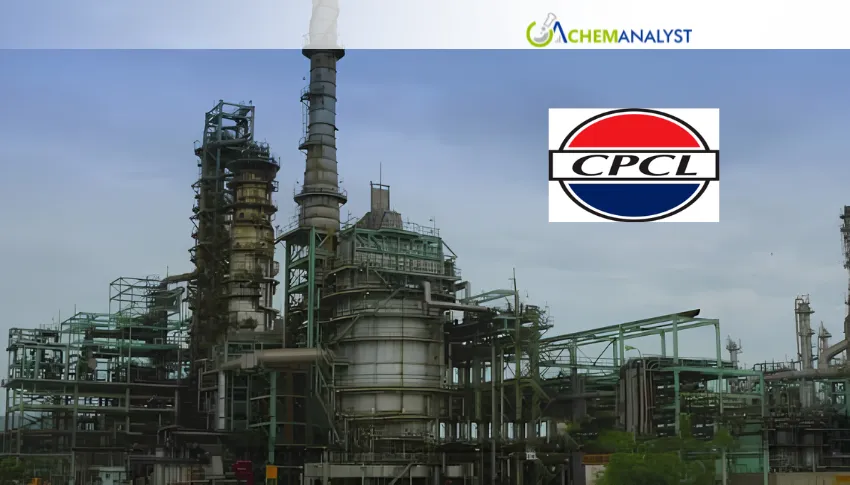
Chennai Petroleum Corporation Ltd. (CPCL), the refining arm of Indian Oil Corporation Ltd. (IOCL), has announced plans to expand the crude processing capacity of its Manali refinery in Tamil Nadu from 210,000 barrels per day (bpd) to 280,000 bpd. The proposed expansion, disclosed in the company's Annual Report 2025-26, reflects CPCL's long-term strategy to enhance refining efficiency while increasing its focus on higher-value petrochemical production.
Although the company has not revealed the investment value or project timeline, the expansion is expected to strengthen CPCL's ability to meet rising domestic demand for transportation fuels and industrial feedstocks. India continues to witness strong growth in fuel consumption, supported by rapid industrialization, infrastructure development, and increasing mobility. Refiners are therefore investing in modern facilities that can process a wider range of crude grades while improving operational flexibility and profitability.
The Manali refinery is one of southern India's key refining assets. It supplies petrol, diesel, aviation turbine fuel (ATF), liquefied petroleum gas (LPG), lubricants, paraffin wax, specialty products, and petrochemical feedstocks to major industrial and commercial markets across the region. The proposed capacity increase is expected to improve economies of scale, enhance production efficiency, and strengthen CPCL's competitiveness in both domestic and export markets.
The expansion also aligns with CPCL's broader downstream strategy. The company has shifted the focus of its Nagapattinam project from a conventional refinery to a petrochemical complex. Earlier this year, Indian Oil increased its stake in the project to 75%, while CPCL retained the remaining 25%. The redevelopment aims to increase petrochemical intensity and produce higher-value chemical products in response to changing market demand.
The strategic transition reflects global industry trends, where refiners increasingly integrate petrochemical production to improve margins as long-term fuel demand growth moderates due to electric vehicles, better fuel efficiency, and decarbonization initiatives. However, India's expanding economy continues to support growth in both transportation fuels and petrochemical consumption, encouraging companies to invest in integrated refinery-petrochemical complexes.
According to the International Energy Agency (IEA), India is expected to expand its refining capacity by around 15% by 2030, supported by sustained investment in refining infrastructure. The Manali expansion and the petrochemical-focused redevelopment of Nagapattinam demonstrate CPCL's commitment to building a more diversified downstream portfolio capable of supporting India's future energy and manufacturing requirements while improving long-term profitability.
Impact on Chemical Commodity Prices Tracked by ChemAnalyst
The expansion of CPCL's Manali refinery and the increased focus on petrochemical production are expected to improve the domestic availability of refinery-derived feedstocks such as naphtha, propylene, and other intermediates over the medium to long term. Higher feedstock availability could ease supply constraints and support stable production of downstream chemicals, including Polypropylene (PP), Polyethylene (PE), Benzene, Toluene, Mixed Xylene, and Paraffin Wax. As domestic capacity expands, import dependence may decline, which could moderate price volatility. However, since the projects are still in the planning stage, no immediate impact on chemical prices is expected. The overall effect is likely to be bearish to stable for several refinery-linked chemical commodities over the long term.







Leave a Comment
Comments (0)