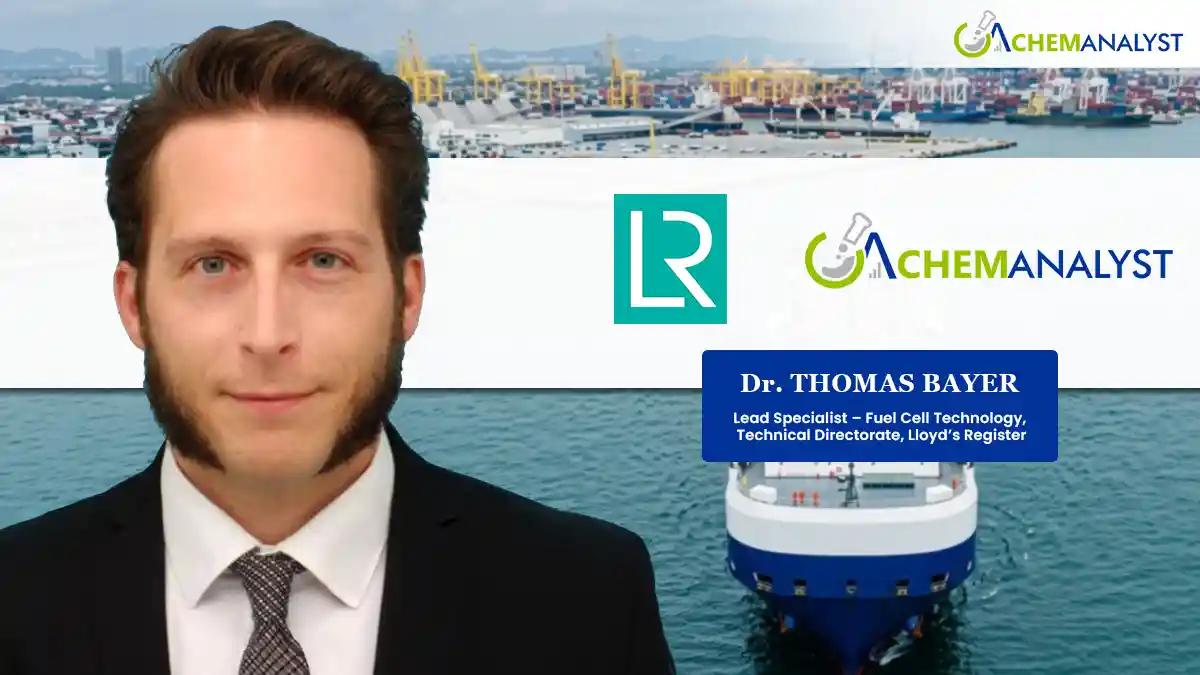
ChemAnalyst Talks with Dr. Thomas Bayer, Lead Specialist – Fuel Cell Technology, Technical Directorate, Lloyd’s Register
Lloyd’s Register (LR), a leading global professional services company specializing in engineering, technology, and risk management for the maritime and offshore industries, was founded in 1760 and is headquartered in London. As a major classification society, LR provides classification and compliance services that help clients design, construct, operate, and manage maritime assets safely while meeting evolving environmental and regulatory standards. Through its technical expertise and advisory services, the company supports the maritime sector’s transition toward safer, more sustainable, and low-carbon operations. ChemAnalyst spoke with Dr. Thomas Bayer, Lead Specialist – Fuel Cell Technology in the Technical Directorate at Lloyd’s Register, about the growing role of hydrogen and fuel cell technologies in shipping. Dr. Bayer discussed the importance of risk-based certification, clear technical guidance, and industry collaboration to support the safe adoption of hydrogen solutions and accelerate the maritime industry’s transition toward zero-emission energy systems.
Complete Interview with Dr. Thomas Bayer
Introduction
Q: Please provide an overview of your professional journey and leadership experience in fuel cell technology and alternative energy systems, and how this background has shaped your strategic perspective on Lloyd’s Register’s role in enabling the safe adoption of hydrogen and zero-carbon technologies across the maritime sector.
Dr. Thomas Bayer: Since 2008, my professional journey has been centred on hydrogen and fuel cell technologies across multiple sectors, giving me a broad and practical understanding of how these systems behave under real operational conditions. I began my career at the German Aerospace Center, working on portable and small-scale marine fuel cell systems as well as early aviation applications. This provided hands on exposure to integration challenges, safety considerations, and the performance realities of deploying fuel cells outside controlled environments.
From 2013 to 2016, I completed my Doctor of Engineering at Kyushu University, Japan’s leading hydrogen research hub. This experience significantly strengthened my technical foundation in fuel cell science, broadened my analytical capabilities, and gave me direct exposure to cutting edge research and international collaborations. It also helped me understand the pathways needed to translate promising research concepts into practical technologies.
I later joined Yanmar, contributing to the development of marine fuel cell power systems, including both reformer-based and hydrogen-fuelled systems. I was also responsible for a project focusing on fuel cell powered heavy duty non-road mobile machinery, which presented additional safety, integration, and regulatory challenges and broadened my cross-sector perspective.
These experiences shape my strategic perspective on Lloyd’s Register’s role in enabling the safe adoption of hydrogen and zero-carbon technologies across the maritime sector. With practical familiarity across both marine and non-marine applications, I can distinguish between real and perceived risks and contribute to requirements that are robust yet proportionate. I recognise the importance of early engagement with industry, transparent and predictable rule frameworks, and close collaboration to accelerate safe uptake. LR’s strength lies in serving as a trusted technical partner, ensuring safety while enabling innovation, and providing industry with the confidence needed to deploy new hydrogen and zero carbon technologies at scale.
Topic 1: LR’s First Guidance Notes for Onboard Hydrogen Generation – Strategy, Scope, and Regulatory Clarity
Q: What is the strategic vision behind Lloyd’s Register issuing the maritime industry’s first dedicated Guidance Notes for onboard hydrogen generation, and why was this step considered necessary at this stage of the industry’s decarbonisation journey?
Dr. Thomas Bayer: Lloyd’s Register’s (LR) decision to issue the industry’s first dedicated Guidance Notes for onboard hydrogen generation reflects a clear strategic assessment of where maritime decarbonisation is realistically heading in the near to medium term. Hydrogen is widely recognised as a critical long-term zero-carbon energy option, but its large-scale deployment is constrained today by infrastructure availability, storage challenges, and cost.
Onboard hydrogen generation has emerged as a pragmatic bridge solution, enabling shipowners and operators to deploy fuel cell technology today without facing the hurdles of hydrogen supply availability, bunkering operations, or dedicated hydrogen storage on board. By producing hydrogen from alternative fuels already widely available, they can begin building valuable operational experience now, positioning themselves for a smoother transition once hydrogen becomes more broadly accessible at scale.
The timing is significant. Regulatory pressure is accelerating through instruments such as the EU ETS and FuelEU Maritime, while the IMO’s hydrogen-specific rules are still evolving. This creates a gap between ambition and practical implementation. The new Guidance Notes respond directly to that gap by giving designers, yards, operators and flag administrations recommendations, based on existing regulations and LR’s experience, on how the safe integration of onboard hydrogen generators may be achieved.
Q: Onboard hydrogen generation is increasingly viewed as a transitional solution amid limited hydrogen bunkering infrastructure. How does LR’s guidance support this bridge strategy while remaining aligned with long-term zero-emission shipping goals?
Dr. Thomas Bayer: Onboard hydrogen generation fits squarely within LR’s view that decarbonisation will be a phased transition rather than a single technological leap. Our recent Fuel for Thought: Hydrogen report highlighted that while hydrogen offers zero tank-to-wake emissions when used in fuel cells, its upstream production is still overwhelmingly fossil-based, with low-emissions hydrogen accounting for less than one percent of global output. At the same time, the physical realities of hydrogen storage, particularly liquid hydrogen at –253°C, impose severe volumetric and operational penalties that limit its immediate applicability to certain vessel types and trades.
By enabling hydrogen to be produced onboard from primary fuels such as methanol or ammonia, shipowners can begin deploying fuel cells and associated electrical architectures today, building operational experience and supply-chain maturity while external hydrogen infrastructure develops. This approach also allows vessels to be designed with future flexibility in mind. Systems can evolve as fuel availability improves, rather than locking operators into a single fuel pathway prematurely.
At the same time, LR recognises that certain ship types may continue to rely on onboard hydrogen generation in the long term, particularly where hydrogen storage constraints make direct hydrogen bunkering impractical. In such cases, using carbon neutral fuels such as green methanol, can allow onboard hydrogen generation to function as a carbon neutral pathway. Likewise, combining onboard hydrogen generation with carbon capture and storage systems, where appropriate, can enable near zero or net zero operation even without transitioning to carbon neutral fuels. This provides operators with multiple viable routes to significantly reduce emissions while maintaining flexibility in future fuel choices.
Topic 2: Role of Classification Societies in Enabling Hydrogen and Fuel Cell Adoption
Q: In an environment where international regulations for hydrogen technologies are still evolving, how critical is the role of classification societies in providing confidence to shipowners, yards, and technology developers?
Dr. Thomas Bayer: In the current regulatory landscape, classification societies play a pivotal role in enabling hydrogen technology adoption. International rules are progressing, but they are not yet comprehensive enough to cover the full range of hydrogen applications now being proposed. Interim IMO guidelines for hydrogen as fuel are only now reaching final approval stages, and that detailed requirements for hydrogen supply systems and onboard use continue to evolve. In this environment, early projects cannot simply wait for fully mature regulations; they require an assurance framework that regulators and insurers can trust.
This is where classification societies add value. By translating high-level safety objectives into engineering expectations, class enables projects to proceed in a structured and defensible way. LR’s approach is grounded in the IGF Code requirement that any hydrogen based installation must demonstrate an equivalent level of safety to systems using natural gas as fuel. Because prescriptive rules currently exist only for natural gas, other gases or low flashpoint fuels, including hydrogen, must follow an alternative design, risk based approval route in accordance with IMO MSC.1/Circ.1455. This ensures that hydrogen technologies are assessed against the same overarching safety objectives that apply to established marine natural gas fuel and power production systems, such as containment integrity, effective leakage detection and safe shutdown, while allowing flexibility in how those objectives are achieved for new technologies. In practice, this approach preserves continuity with conventional marine safety expectations while enabling the safe integration of emerging hydrogen solutions where prescriptive regulations are still developing.
Without this structured approach, the risk would be fragmentation: different interpretations by different stakeholders, inconsistent approval outcomes, and ultimately reduced confidence in hydrogen solutions. Classification provides the common technical language that allows innovation to scale beyond isolated pilot projects.
Q: From a safety and assurance perspective, how does Lloyd’s Register balance encouraging innovation in hydrogen and fuel cell systems with its responsibility to manage risk and ensure regulatory compliance?
Dr. Thomas Bayer: Encouraging innovation while safeguarding life, assets and the environment requires discipline as much as openness. Our approach is deliberately risk-based rather than prescriptive, consistent with the Alternative Design and Arrangements (ADA) process embedded in the IGF Code. The ADA framework is intended to enable innovative solutions while ensuring that alternative designs meet the goal and functional requirements of the applicable regulations. LR’s hydrogen rules similarly allow for alternative arrangements that deviate from the prescriptive rule text, provided they demonstrate an equivalent level of safety through a risk based certification approach. To support this, LR has developed the ShipRight Risk Based Certification (RBC) procedure, aligned with IMO guidelines including MSC.1/Circ.1455 for alternative designs, MSC.1/Circ.1002 for fire-safety, and MSC.1/Circ.1212/Rev.2 for ADA under SOLAS Chapters II-1 and III.. This risk based and goal oriented framework is reflected in LR’s technical Guidance Notes for hydrogen and fuel cell power installations.
LR’s GN-016 Guidance Notes for the Installation of Fuel Cells on Ships illustrates how this balance between innovation and safety assurance is achieved in practice. Concepts such as gas-safe and ESD-protected fuel cell spaces provide designers with clear architectural options, each with defined safety strategies and requirements. Requirements for ventilation performance, gas detection thresholds, automatic shutdown logic and fire protection are conservative where evidence is still emerging, but they are also transparent. Developers know what is expected and why.
This approach supports innovation because it focuses on outcomes rather than prescribing technology. At the same time, it manages risk by insisting that claims of safety equivalence are supported by analysis, testing and verification. As operational experience grows, these requirements can evolve, but they are never relaxed without evidence. That balance is central to LR’s credibility as both an enabler and a guardian of safety.
Topic 3: Global Hydrogen Market – Technology Readiness, Costs, and Adoption Outlook
Q: From Lloyd’s Register’s global vantage point, how would you assess the current readiness of fuel cell and reforming technologies for marine and offshore applications?
Dr. Thomas Bayer: From a technology perspective, hydrogen technologies are often more mature than they appear. Fuel cells, in particular, have accumulated extensive operating hours in automotive and stationary power applications, and well-understood performance characteristics. What remains limited is large-scale marine experience, especially in demanding offshore and deep-sea environments.
For marine applications, the requirements are significantly more stringent than in automotive: systems must demonstrate reliable performance and robustness in harsh marine environments, including continuous vibration and ship motion, and they must deliver longer service intervals and higher durability that align with vessel operating schedules and lifetime expectations. Achieving this will require further technological development, and these enhanced durability levels will need to be demonstrated under real marine operating conditions.
Onboard hydrogen generation adds another layer of complexity by introducing process equipment that must operate reliably across a wide range of conditions. Marine experience with these systems is even more limited, as most reforming and process-intensive hydrogen-generation technologies originate from land-based stationary applications. Their robustness under continuous vessel motion, vibration, pitch and roll, and dynamic load changes is therefore far less proven, making operational reliability and environmental hardening key areas that still require demonstration at sea.
Q: Are there specific vessel segments or geographic regions where you expect hydrogen and onboard hydrogen generation technologies to gain traction faster, and what factors are driving this momentum?
Dr. Thomas Bayer: Early adoption of hydrogen in shipping is likely to remain concentrated in short-sea and fixed-route operations. These segments can better accommodate hydrogen’s storage challenges and benefit from predictable bunkering arrangements. The Fuel for Thought report explicitly links current hydrogen vessel development to short-sea routes, where frequent refuelling mitigates volumetric penalties.
Projects such as the Norwegian hydrogen ferries and Swiss passenger vessels illustrate this pattern. They operate in regions with strong policy support, access to renewable energy and a willingness to invest in first-of-a-kind infrastructure. Regulatory incentives also play a role. FuelEU Maritime’s multiplier for renewable fuels of non-biological origin materially improves the compliance case for green hydrogen in the near term.
Deep-sea adoption will progress more slowly, not because hydrogen is unsuitable in principle, but because storage, cost and infrastructure challenges scale with voyage length. For these segments, onboard hydrogen generation may offer a more practical route, as it reduces reliance on large-scale hydrogen storage and leverages alternative primary fuels with higher volumetric energy density such as methanol, ammonia or natural gas. In this context, our guidance is designed to support the frontrunners while preparing the ground for broader deployment as technology, fuel availability and regulatory frameworks mature.
Topic 4: Regulatory, Safety, and Certification Challenges for Onboard Hydrogen Systems
Q: Onboard hydrogen generation introduces complex safety considerations. What are the most critical risks designers and operators must address to ensure safe integration?
Dr. Thomas Bayer: Onboard hydrogen generation introduces a unique combination of hydrogen specific hazards and process equipment risks that must be carefully addressed to ensure safe integration.
Hydrogen itself presents well known challenges: it has an exceptionally wide flammability range and a very low ignition energy, making even small leaks potentially hazardous, with escalation potential in confined shipboard environments to severe explosions. Its low density also leads to accumulation in overhead spaces, requiring well designed ventilation and gas detection systems that account for space geometry and internal structures.
When onboard hydrogen generation is used, the vessel effectively carries two hazardous substances, the primary fuel and the hydrogen produced, which naturally increases complexity. Each fuel has different flammability, dispersion and ignition characteristics, so the risks cannot be assessed in isolation. Accordingly, LR calls for strict segregation, clearly defined hazardous zones, integrated risk analysis and supporting safety actions to prevent the hazards associated with one substance from affecting the safety envelope of the other.
In addition, most reforming technologies come from land based applications, meaning their behaviour under ship motion, vibration and confined space conditions is far less proven. Bringing these factors together, the combination of multiple fuels, more interfaces, and limited marine operational experience makes a structured, cross system risk assessment essential to ensuring safe integration on board.
Compounding these risks is the absence of mature international regulations for onboard hydrogen generation, which means designers cannot rely on prescriptive rules alone. As a result, they must follow risk based approval routes and use LR’s Guidance Notes to demonstrate that hazards have been systematically addressed and that safety outcomes are consistent and credible for the proposed installation.
Q: How do LR’s Guidance Notes apply risk-based methodologies—such as hazard identification and safety studies—to support plan approval, certification, and operational assurance for hydrogen generator systems?
Dr. Thomas Bayer: The approach to hydrogen technology certification is built around structured risk assessment rather than prescriptive checklists. This reflects the reality that hydrogen systems vary widely and that safety must be demonstrated, not assumed. LR’s requirements are scalable to risk and grounded in its ShipRight Risk Based Certification (RBC) framework, which provides a structured process for assessing novel or alternative designs and demonstrating an equivalent level of safety in line with IMO MSC.1/Circ.1455.
Our Guidance Notes emphasise that onboard hydrogen generation cannot rely on prescriptive rules only and require a formal risk based certification approach. They explain that novel technologies must demonstrate safety through systematic design review, hazard identification, risk assessment and verification activities, and therefore guide readers toward LR’s RBC process. RBC provides the necessary framework for evaluating alternative or innovative systems when prescriptive requirements are insufficient or missing, ensuring that hydrogen generator installations are assessed with the same rigour and transparency as, for example, fuel cell power systems.
The Guidance Notes for onboard hydrogen generation support this methodology by recognising the challenge of adapting land based hydrogen generation technologies to the marine environment. They set out recommendations for design, testing and verification that collectively support a defensible safety case. This gives regulators and operators confidence that the safety of hydrogen generator installations can be demonstrated through a transparent, evidence based process.
Topic 5: Future Outlook – Projects, Pilots, and LR’s Hydrogen Roadmap
Q: What types of hydrogen, fuel cell, or onboard hydrogen generation projects and pilot programmes is Lloyd’s Register currently involved in, and as more hydrogen-based projects move from concept to execution, how do you see LR’s guidance evolving to keep pace with technological maturity and operational experience?
Dr. Thomas Bayer: LR has been involved in a wide range of past and ongoing fuel cell vessel projects, covering both low and high temperature fuel cell technologies and using a variety of fuels, from LNG and methanol to hydrogen. These include liquid hydrogen fuelled cruise ship concepts with portable LH2 tanks (e.g., the EU-funded SHYPS project), hybrid LH2 powered superyachts, gaseous hydrogen fuelled ferries, gas carriers and harbour craft such as tugs. Many of these projects feature multi megawatt scale fuel cell power installations, reflecting the wider move toward hydrogen fuelled ship concepts.
LR is also seeing strong engagement from hydrogen technology providers seeking Approval in Principle or Type Approval for their technologies, driven by the need to reduce regulatory uncertainty and accelerate commercial readiness.
As more projects progress and operational evidence builds, LR’s guidance evolves accordingly: refining recommendations on safeguards and redundancy, strengthening testing requirements to demonstrate robustness and performance in the marine environment, and optimising safety concepts and approval processes.
One likely trajectory is the emergence of standardised design patterns for hydrogen and fuel cell systems. As these patterns are proven across multiple projects, they can be codified, reducing uncertainty and cost. The Guidance Notes for onboard hydrogen generation represent an important step in this direction, capturing early best practice in a form that can be updated and further developed as evidence grows.
Importantly, real project experience does not only inform design guidance, it also shapes the future development of rules and standards. Lessons learned from commissioning, integration challenges, near misses and operational behaviour feed directly into LR’s internal rule development processes and our contributions to IMO and other regulatory bodies. This ensures that as the technology matures, the regulatory environment matures with it.
Overall, this adaptive, evidence driven approach ensures that LR’s guidance remains relevant, practical and aligned with real world conditions, supporting a smooth transition from early pilots to widespread, safe adoption of hydrogen technologies.
Q: Looking ahead, what role will Lloyd’s Register play in shaping future rules, standards, and advisory services to support the maritime and offshore sectors’ transition toward hydrogen and other zero-carbon energy solutions?
Dr. Thomas Bayer: A key part of LR’s contribution will be the proactive development of guidance, standards and risk based methodologies ahead of formal international regulation, just as we have done with our Guidance Notes for Onboard Hydrogen Generation. By doing so, we provide industry with the clarity and technical governance needed to progress projects without having to wait for prescriptive rules. At the same time, LR will continue to support international rulemaking through the IMO and other collaborative platforms, ensuring that future regulations reflect practical experience, robust safety principles and lessons learned from early deployments.
In parallel, our advisory services will help shipowners, yards and technology developers navigate technology choices, integration challenges and operational risks. This includes modelling and data driven tools that provide the evidence needed for informed technology selection and ship integration. Importantly, LR also provides a counterbalance to over optimistic narratives by helping operators understand where hydrogen makes sense, where alternatives may be more appropriate, and what operational and infrastructural implications must be realistically considered.
In short, LR’s future role is to combine technical expertise, independent assurance and regulatory leadership to give the industry confidence in deploying hydrogen and other zero carbon technologies safely, responsibly and at scale.








 About ChemAnalyst
Leave a Comment
Comments (0)