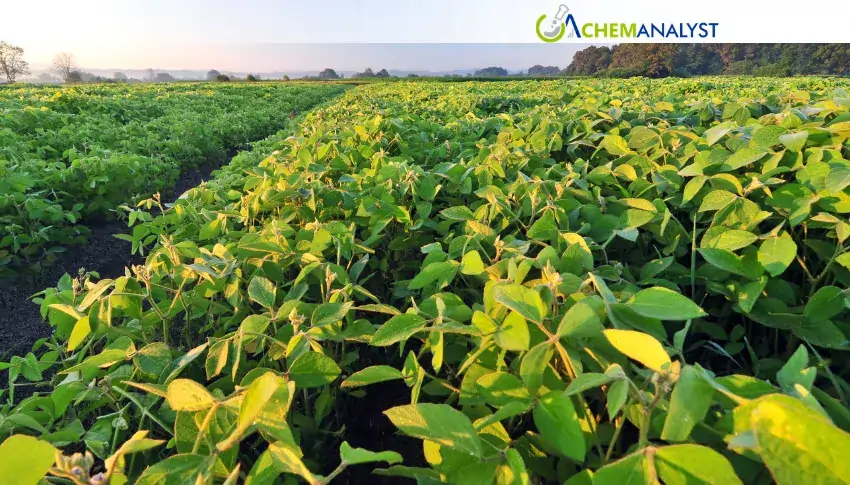
Germany is on track for its largest soybean harvest ever in 2026, with production expected to increase by 21% to 159,000 tonnes. This growth is a significant development for the country, highlighting its increasing role in providing domestic protein crops. Germany's success contrasts with a projected 1% decline in overall EU-27 soybean production for the 2026/2027 marketing year, which is forecast to be just under 2.8 million tonnes.
Several factors contribute to Germany's anticipated record soybean yield. The country has seen a noticeable expansion in its grain legume area, including dry peas, broad beans, and soybeans. This expansion aligns with a broader trend of crop diversification, driven by rising demand for non-genetically modified (GM-free) feed and the need for stronger national and EU protein strategies. The Union zur Förderung von Oel- und Proteinpflanzen (UFOP) notes a positive long-term trend, with EU soybean production tripling over the past decade.
While Germany thrives, the overall EU soybean production faces a slight decline, primarily due to a sharp 15% fall in Italian production, expected to reach 899,000 tonnes—its lowest in five years. Italy remains the largest producer in the bloc despite this reduction. France, the second-largest supplier, anticipates a 4% output increase to 408,000 tonnes, with other member states also showing modest gains.
A significant challenge to future EU soybean expansion is the European Commission's plan to classify soybeans as a high indirect land-use change (iLUC) risk feedstock. This classification would undermine further growth and could lead to a sharp decline in domestic soya cultivation by reducing demand for European-grown soybeans. The European Parliament's ITRE Committee has already backed a motion to reject this proposal. Critics argue that this policy contradicts the EU Protein Strategy, which aims to expand European protein crop production and reduce reliance on imported proteins.
Germany's increased soybean production helps meet domestic protein demand, particularly for GM-free feed. This reduces the country's reliance on imported protein sources. However, the potential EU-wide decline and the iLUC classification could jeopardize the entire European protein sector. Weakening European production may increase the EU's dependence on imported soybean meal, much of which comes from regions with documented deforestation risks.
The reorientation of crushing capacity towards larger rapeseed and sunflower harvests is also expected to contribute to a decline in EU soybean crushing. Furthermore, the profitability of EU field crops is projected to decline in 2026, influenced by factors such as lower grain prices and increased input costs due to geopolitical situations. The EU has already seen its soybean imports fall to a three-year low from July 2025 to mid-March 2026, largely due to a decline in the EU pig population. This highlights the complex interplay between agricultural policies, market dynamics, and livestock farming within the EU.
Impact on the Product:
Germany's record soybean harvest will strengthen the country's domestic soybean supply, particularly for GM-free feed production, reducing dependence on imported soybean meal. Higher local availability will benefit the animal feed, vegetable oil, and food processing industries while improving supply chain resilience. However, the broader EU market remains under pressure due to declining production in Italy, reduced soybean crushing, and uncertainty surrounding the European Commission's proposed high iLUC-risk classification for soybeans. If the proposal is implemented, long-term investment in European soybean cultivation could weaken despite Germany's strong performance. Increased rapeseed and sunflower processing may also divert crushing capacity away from soybeans, limiting value-added soybean product production across the region.
Impact on Prices of Chemical Commodities Tracked by ChemAnalyst
Germany's record soybean harvest is expected to exert slight downward pressure on prices of soybean-derived products such as soybean oil, soybean meal, and lecithin within Germany due to improved domestic availability. Lower dependence on imports may temporarily ease procurement costs for food, feed, and oleochemical manufacturers. Soybean oil serves as a key feedstock for fatty acids, fatty alcohols, methyl esters (biodiesel), glycerine, and surfactants, which could see marginal cost relief if domestic crushing increases. However, the overall impact on European chemical commodity prices tracked by ChemAnalyst is expected to remain limited, as EU soybean production is still projected to decline slightly, with lower output in Italy and reduced crushing activity offsetting Germany's gains. Furthermore, uncertainty over the proposed iLUC classification may discourage future soybean cultivation and processing investments. Consequently, while Germany's bumper harvest may soften regional feedstock costs in the short term, broader EU supply constraints are likely to keep soybean-based chemical commodity prices largely stable with a slight bearish bias.







Leave a Comment
Comments (0)