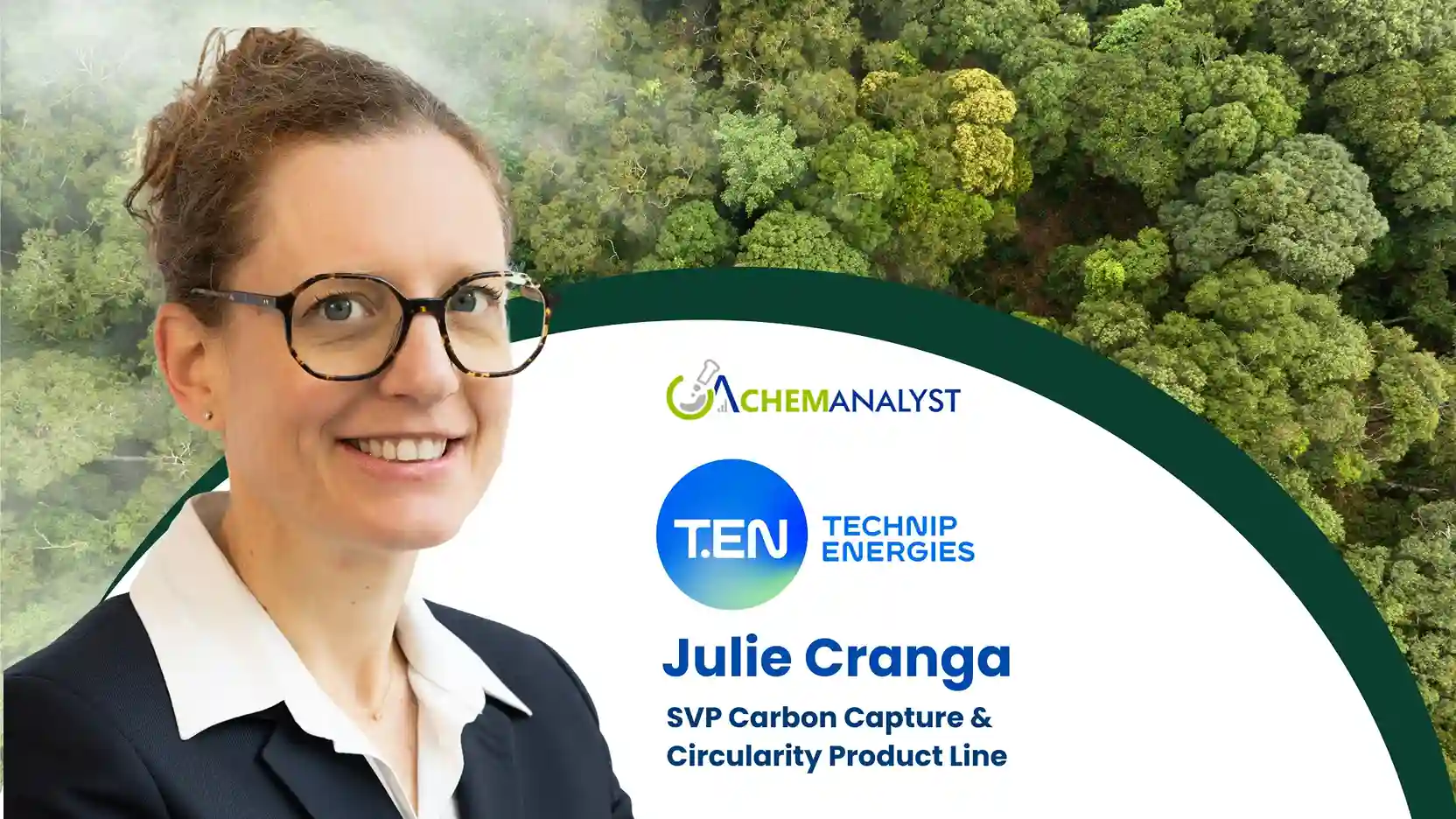
ChemAnalyst Talks with Ms. Julie Cranga, SVP Carbon Capture & Circularity Product Line, Technip Energies
Technip Energies, a global technology and engineering powerhouse, is at the forefront of advancing the energy transition through its leadership in LNG, hydrogen, ethylene, sustainable chemistry, carbon capture, and circularity solutions. Leveraging its complementary Technology, Products and Services (TPS) and Project Delivery (PD) business segments, the company transforms innovative technologies into scalable industrial solutions that help accelerate decarbonization and resource efficiency. As industries worldwide intensify efforts to reduce plastic waste and meet increasingly stringent recycled-content regulations, Technip Energies is playing a pivotal role in commercializing advanced chemical recycling technologies that enable the conversion of difficult-to-recycle plastic waste into valuable circular feedstocks. Through its strategic collaboration with Alterra and Neste, the company has developed a standardized modular chemical recycling solution designed to reduce project risk, improve bankability, accelerate deployment, and support the industrial-scale expansion of the circular plastics economy.
ChemAnalyst spoke with Ms. Julie Cranga, Senior Vice President, Carbon Capture & Circularity Product Line, Technip Energies, about the company's vision for accelerating plastic circularity through industrial-scale chemical recycling. Drawing on more than two decades of international leadership experience across energy infrastructure, digital transformation, project execution, and decarbonization, Ms. Cranga discussed the strategic drivers behind Technip Energies' standardized recycling offering, the growing impact of global recycled-content mandates, and the importance of collaboration in scaling circular economy solutions. She also shared insights into how digitalization, modular engineering, life cycle assessment, and strategic partnerships are improving project economics, operational efficiency, and supply chain resilience. Furthermore, she highlighted Technip Energies' long-term commitment to advancing carbon capture and circularity by delivering proven, bankable technologies and products that strengthen local feedstock security, reduce environmental impact, and help build a commercially sustainable global circular plastics ecosystem.
Complete Interview with Ms. Julie Cranga
Q1. You have spent more than two decades in the global energy industry, leading initiatives across project management, digital transformation, human resources, and decarbonization. How have these diverse leadership experiences shaped your vision for advancing the global circular plastics economy?
Julie Cranga: I joined Technip Energies more than 20 years ago because I wanted to contribute to building the critical energy infrastructure the world requires while working alongside talented people who share strong values and a common purpose. That pioneering spirit continues to guide our work today.
Our ambition in plastic circularity is clear—we want to provide customers with proven, investable pathways that enable them to close the loop on plastic waste at an industrial scale. Success in this market requires both technical excellence and commercially viable business models. By combining our engineering expertise with strong execution capabilities, we are helping customers accelerate the transition toward a more circular and sustainable plastics industry.
Q2. Technip Energies recently introduced a standardized modular solution for advanced chemical recycling. What strategic market developments made this the right time to accelerate deployment?
Julie Cranga: Several important market developments have aligned to create the right environment for large-scale deployment of chemical recycling.
First, governments around the world are introducing regulations that encourage greater plastic circularity. Regulatory frameworks are becoming the primary driver of investment in advanced recycling infrastructure.
Second, the required technologies have now reached commercial maturity. Through our partnership with Alterra and Neste, we are bringing together complementary expertise that enables industrial-scale deployment.
Technip Energies and Neste have collaborated successfully for many years on renewable fuels, while our cooperation with Alterra began in 2022. Building on these relationships, we announced our three-party agreement to develop a standardized technology solution for advanced chemical recycling, designed for commercial deployment, and supporting the growing demand for recycled plastics.
Q3. One of the industry's biggest challenges is scaling advanced recycling from demonstration projects to commercial operations. What are the primary technical and financial barriers, and how is Technip Energies addressing them?
Julie Cranga: The starting point is having a technology that has already demonstrated commercial performance. Alterra's pyrolysis technology has been operating continuously at industrial scale for more than five years. During this period, it has successfully processed mixed plastic waste while producing more than one thousand truckloads of pyrolysis oil supplied to customers.
Technip Energies complements this proven technology with extensive expertise in industrialization, project delivery, and engineering standardization.
Instead of designing every facility from the beginning, we have developed a standardized engineering package that can be deployed repeatedly. The modular design reduces on-site construction activities, improves safety, shortens project schedules, increases cost certainty, and significantly accelerates time to revenue.
This standardized approach also improves project bankability by reducing technical and execution risks. Combined with Neste's extensive expertise in recycling markets and feedstock management, it creates a stronger investment proposition for project developers and financial institutions.
Q4. Plastic waste streams are highly variable and often difficult to recycle. How does your technology maintain operational efficiency while processing mixed and complex plastic feedstocks?
Julie Cranga: Chemical recycling offers an important advantage over conventional mechanical recycling because it can process complex plastic waste streams that are otherwise extremely difficult to recycle.
Global plastic production has more than doubled over the past two decades and now exceeds 450 million tonnes annually. However, less than 10% of plastic waste is currently recycled, with most material ending up in landfills, incinerators, or the natural environment.
This growing challenge requires more efficient recycling solutions.
Pyrolysis technology enables the processing of mixed plastics, flexible packaging, and other difficult-to-recycle materials that cannot be effectively recycled through mechanical methods. These waste streams represent a significant portion of global plastic production, making advanced chemical recycling an essential component of achieving a circular plastics economy.
Q5. Digital technologies are transforming industrial operations worldwide. How can digital solutions such as advanced process control, digital twins, and AI improve the performance of chemical recycling facilities?
Julie Cranga: Digital technologies are becoming an integral part of every solution delivered by Technip Energies.
We use digital tools to continuously monitor plant performance, optimize operations, and help customers reduce operating costs. These technologies improve process efficiency while supporting predictive maintenance and operational reliability.
Within the circular economy, digitalization also plays a critical role in ensuring material traceability throughout the recycling value chain. Reliable traceability builds confidence among customers, regulators, and brand owners by verifying the origin and movement of recycled materials.
As regulatory requirements continue to evolve, digital solutions will become increasingly important for demonstrating compliance while enhancing transparency across the entire recycling ecosystem.
Q6. What engineering innovations have been incorporated into your standardized chemical recycling solution to improve energy efficiency while reducing the overall carbon footprint?
Julie Cranga: Our approach extends beyond standardizing engineering design. We have also standardized the supply chain, qualified key equipment vendors, and optimized construction methodologies to improve execution efficiency.
By using a modular design philosophy, every component has been carefully engineered to achieve the best balance between capital expenditure, operational performance, constructability, and long-term reliability. This standardized approach minimizes engineering repetition while reducing project complexity and accelerating deployment.
Energy efficiency has been integrated into every stage of the design process. We continuously optimize equipment selection, process configuration, and operational performance to lower energy consumption, reduce operating costs, and improve overall carbon performance.
In addition, Technip Energies systematically performs Life Cycle Assessments (LCAs) for its technologies to quantify their environmental benefits and demonstrate the positive contribution chemical recycling can make toward reducing greenhouse gas emissions and supporting a circular plastics economy.
Q7. Governments worldwide are introducing stricter recycled-content mandates and circular economy regulations. How do you expect these policies to influence investment in chemical recycling over the next five years?
Julie Cranga: The global regulatory landscape is creating one of the strongest growth drivers for advanced recycling.
Many countries are shifting from voluntary sustainability initiatives to mandatory recycled-content requirements across consumer products. These regulations require manufacturers to incorporate increasing percentages of recycled plastic into packaging and other applications, with targets expected to range between approximately 10% and 40% by 2030–2040.
The European Union's Packaging and Packaging Waste Regulation (PPWR) is a good example. It establishes minimum recycled-content requirements for plastic packaging and creates direct demand for high-quality recycled materials.
As these regulations take effect, demand for recycled plastics is expected to increase significantly. At the same time, current recycling capacity remains insufficient to meet future requirements, creating a considerable supply gap.
This imbalance presents a major investment opportunity for advanced recycling technologies. Technip Energies is committed to accelerating industrial-scale deployment to help bridge this gap and support the transition toward a circular plastics economy.
Q8. What are the primary commercial concerns raised by petrochemical producers, project developers, and brand owners when evaluating investments in chemical recycling infrastructure?
Julie Cranga: Petrochemical companies that purchase pyrolysis oil as feedstock require technologies that have demonstrated reliable commercial performance. Their primary priorities include proven process reliability, competitive project economics, guaranteed operational performance, and consistent product quality.
Technip Energies addresses these expectations through standardized engineering, proven technology, and close collaboration with strategic partners across the recycling value chain. This integrated approach helps ensure feedstock quality while reducing project risks.
Project developers focus heavily on investment certainty. They seek solutions that minimize technical uncertainty, improve project bankability, and accelerate returns on investment. Our standardized modular approach directly addresses these concerns by reducing engineering complexity, shortening project schedules, and improving cost predictability.
Waste management companies also represent an important customer segment. Chemical recycling enables them to transform plastic waste into valuable feedstocks, creating additional revenue streams while supporting broader sustainability objectives.
Q9. Competition for waste-derived feedstocks is increasing across industries, including chemical recycling, renewable fuels, and sustainable aviation fuel. Do you expect feedstock availability to become a significant constraint for the plastics recycling industry?
Julie Cranga: From a plastics perspective, feedstock availability is not the primary challenge.
Unfortunately, plastic waste remains abundant worldwide. The greater opportunity lies in improving collection systems, sorting infrastructure, and waste management practices to ensure that more plastic waste enters recycling streams instead of landfills or the environment.
Across several regions, we are already seeing meaningful progress in waste collection and sorting capabilities. As these systems continue to mature, they will provide a more reliable and efficient supply of suitable feedstock for advanced recycling facilities.
Therefore, the key priority is not increasing plastic waste availability, but improving the organization and efficiency of the collection and recycling ecosystem.
Q10. Looking ahead, what technological advancements do you believe will have the greatest impact on improving the commercial viability and scalability of chemical recycling?
Julie Cranga: Future progress will depend not only on advances in recycling technologies themselves but also on improvements across the entire value chain.
Enhancing collection systems, feedstock preparation, purification technologies, and downstream processing will all contribute to making advanced recycling more economically attractive and commercially scalable.
One particularly important area of innovation is the purification of pyrolysis oil produced during chemical recycling. Improving purification technologies ensures that recycled feedstocks consistently meet the quality requirements of petrochemical producers manufacturing new plastics.
Maintaining high product quality throughout the value chain is essential for building market confidence, supporting regulatory compliance, and enabling wider commercial adoption.
Technip Energies continues to invest in purification technologies and other innovations that strengthen the quality, efficiency, and competitiveness of advanced recycling solutions while supporting long-term circularity objectives.
Q11. Looking beyond technology, what is your long-term vision for Technip Energies' role in transforming plastic waste into valuable circular resources?
Julie Cranga: Our ambition is to help create a true circular market for plastics rather than treating plastic waste solely as a waste management challenge. We believe plastic circularity must evolve into a sustainable industrial ecosystem where waste is recognized as a valuable resource that can be reintegrated into the production of new materials.
Achieving this vision requires more than advanced recycling technologies. It depends on industrializing circularity across the entire value chain—from waste collection and sorting to recycling, purification, and the manufacturing of new plastic products. Success will only be possible through close collaboration among technology providers, engineering companies, petrochemical producers, waste management companies, regulators, and brand owners.
Technip Energies' role is to bring together proven technologies, strategic partnerships, and world-class execution capabilities to make advanced recycling scalable, commercially viable, and impactful on a global scale.
Q12. How important are strategic partnerships in accelerating the commercialization of advanced recycling technologies?
Julie Cranga: Partnerships are fundamental to building a successful circular plastics economy because no single company possesses every capability required to transform the industry.
Each partner contributes unique expertise. Alterra provides proven pyrolysis technology, Neste contributes extensive knowledge of recycling markets and downstream applications, while Technip Energies delivers engineering excellence, project execution, and industrial-scale deployment capabilities.
By combining these complementary strengths, we can significantly reduce project risk, accelerate commercialization, and offer customers an integrated solution that is both technically reliable and commercially attractive.
Ultimately, collaboration enables us to move faster and deliver greater value across the entire plastics recycling ecosystem.
Q13. How does local sourcing of recycled feedstock strengthen supply chain resilience in an increasingly uncertain geopolitical environment?
Julie Cranga: Recent geopolitical developments have highlighted the vulnerability of global supply chains, particularly those dependent on conventional fossil-based feedstocks transported over long distances.
Chemical recycling offers a unique opportunity to localize feedstock sourcing by converting plastic waste generated within a region into valuable raw materials for local manufacturing.
Deploying recycling facilities close to waste generation and collection points, as well as near petrochemical production assets, shortens supply chains, improves resource security, reduces transportation requirements, and strengthens supply resilience.
In many ways, circularity is inherently local. Building regional recycling ecosystems allows countries and industries to become less dependent on imported feedstocks while improving both environmental and economic sustainability.
Q14. What do you see as the biggest opportunity for advancing the chemical recycling industry over the coming decade?
Julie Cranga: The greatest opportunity lies in making advanced recycling commercially scalable through continuous improvements across the entire value chain.
Technology innovation will remain important, but equal attention must be given to improving feedstock collection, sorting infrastructure, purification technologies, engineering standardization, and market collaboration.
As regulations continue to encourage recycled content and customer demand for sustainable materials increases, the industry has a significant opportunity to build an economically viable circular plastics market.
By delivering reliable technologies, reducing project risks, and strengthening collaboration among industry participants, advanced recycling can become an integral component of the global plastics value chain.
Q15. Finally, what message would you like to share with ChemAnalyst's global audience regarding the future of plastic circularity and Technip Energies' commitment to sustainable innovation?
Julie Cranga: Plastic circularity represents one of the most important industrial transformations currently underway. We believe the future of the plastics industry will be defined by collaboration, innovation, and the ability to industrialize sustainable solutions at scale.
Technip Energies is committed to accelerating this transition by delivering proven technologies, standardized engineering solutions, and strong execution capabilities that enable customers to invest with confidence.
Our objective is not only to recycle plastic waste but to help create an entirely new circular market where valuable resources remain in use for longer, reducing environmental impact while strengthening supply security.
Through strategic partnerships, technological innovation, and industrial expertise, we are committed to making advanced chemical recycling scalable, bankable, and globally accessible — helping build a more sustainable and resilient future for the plastics industry.







Leave a Comment
Comments (0)