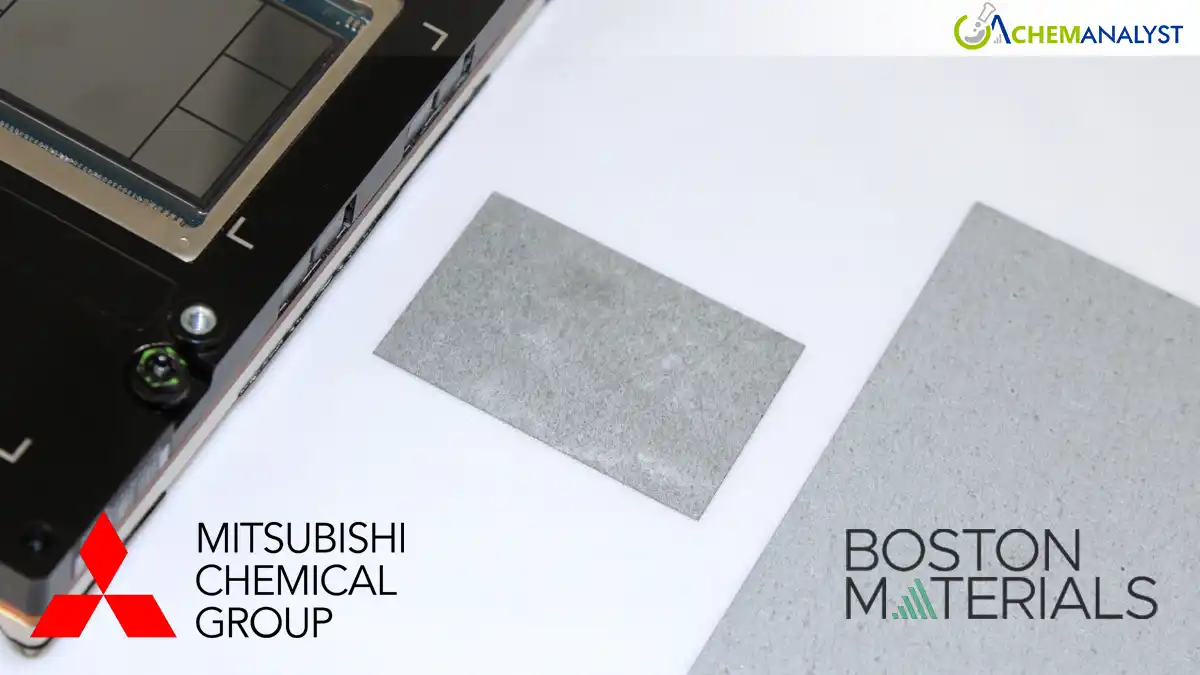
Mitsubishi Chemical Group (MCG), a global leader in advanced and high-performance materials, has announced a strategic collaboration with Boston Materials, Inc., an innovator in energy transfer and thermal management materials. This partnership marks a significant step toward addressing one of the most critical challenges facing the semiconductor industry today—efficient thermal management for high-performance computing (HPC) and artificial intelligence (AI) data center applications.
As part of the collaboration, Mitsubishi Chemical Group’s U.S.-based corporate venture capital arm, Diamond Edge Ventures, has made a strategic investment in Boston Materials. Beyond financial backing, the partnership is designed to combine the complementary strengths of both organizations to accelerate innovation and commercialization in semiconductor thermal interface materials (TIMs). The primary focus of the collaboration is the joint development of the second-generation Liquid Metal ZRT® product, a next-generation thermal interface solution developed by Boston Materials.
Liquid Metal ZRT® is a breakthrough TIM that leverages Boston Materials’ patented Z-axis Carbon Fiber™ architecture along with proprietary liquid metal alloys. This unique combination enables superior heat transfer performance compared to conventional and emerging thermal management solutions. By improving heat dissipation efficiency at the chip and package level, the technology directly addresses a major performance bottleneck in modern semiconductors, particularly those used in AI accelerators, graphics processing units (GPUs), and application-specific integrated circuits (ASICs) operating at kilowatt-scale power levels.
According to Curtis Schickner, President of Diamond Edge Ventures, the semiconductor sector has reached a pivotal moment where further performance gains depend heavily on materials innovation rather than traditional scaling alone. He emphasized that thermal management has emerged as one of the most pressing constraints on continued performance improvements. Mitsubishi Chemical Group has thoroughly evaluated Boston Materials’ Liquid Metal ZRT technology and validated its superior performance relative to existing and next-generation alternatives. On this basis, Boston Materials was selected as a strategic partner to strengthen MCG’s expanding portfolio of high-performance semiconductor material solutions.
Boston Materials has already demonstrated strong market traction with the successful commercialization of its first-generation Liquid Metal ZRT product, LMZ1100. This product has delivered industry-leading results, achieving more than a 10°C temperature reduction in liquid-cooled, high-power ASICs and GPUs. In addition to its exceptional thermal performance, LMZ1100 has proven to be reliable over long operational lifetimes, making it well-suited for data center environments that demand continuous uptime. Importantly, the product is also compatible with high-volume manufacturing (HVM) processes, a critical requirement for widespread semiconductor adoption.
Building on this foundation, the strategic partnership will support the development of the second-generation Liquid Metal ZRT product, which is expected to offer further improvements in both thermal efficiency and long-term reliability. The collaboration will also focus on integrating this advanced material into high-volume semiconductor packaging and assembly workflows, helping accelerate its adoption across global supply chains.
For Mitsubishi Chemical Group, the partnership aligns closely with its broader strategy to position itself as a premier supplier of functional and high-performance materials for the semiconductor industry. To support commercialization and regional deployment, MCG plans to establish advanced semiconductor packaging integration and application development laboratories across Asia. These facilities will play a key role in enabling mass adoption of the second-generation Liquid Metal ZRT technology, particularly in the Asia-Pacific (APAC) region, which remains central to global semiconductor manufacturing.
Anvesh Gurijala, Chief Executive Officer of Boston Materials, highlighted that thermal management has become a defining constraint in the rapid expansion of AI infrastructure worldwide. He noted that Boston Materials’ Liquid Metal ZRT technology was developed specifically to overcome this challenge, and that partnering with Mitsubishi Chemical Group will significantly expand the company’s global reach while accelerating its product development roadmap. Through this collaboration, both companies aim to unlock new levels of performance and reliability for next-generation semiconductor systems.







Leave a Comment
Comments (0)