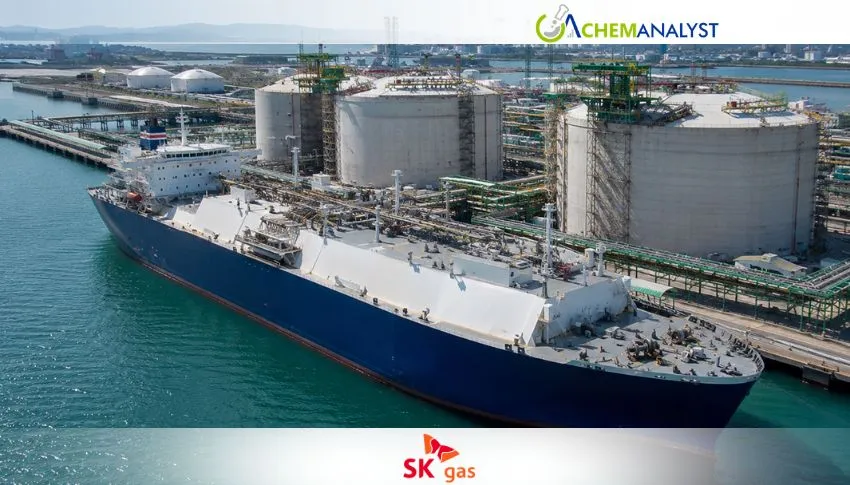
SK Gas's "SWAN 2.0" strategy is a mid-to-long-term growth plan focused on expanding its liquefied natural gas (LNG) and hydrogen businesses, driving significant profit growth. This strategy, initiated with a vision announced in 2020, aims to create new growth axes by interconnecting existing operations. The company's pretax profit between 2020 and 2024 has tripled compared to the 2015-2019 period, reflecting the strategy's early successes.
The foundation of SWAN 2.0 is robust LNG infrastructure. Ulsan GPS, the world's first gigawatt-class power plant capable of using both LNG and liquefied petroleum gas (LPG), commenced stable operations last year. SK Gas finalized a 1.2 trillion Korean won equity sale of Ulsan GPS on June 30, securing substantial financial capacity. The Korea Energy Terminal (KET) also completed its third tank on July 1, enhancing LNG supply capabilities. A fourth tank at KET is expected by early 2027, further strengthening the entire LNG value chain from import and storage to supply and power generation.
Leveraging this expanded infrastructure, SK Gas is accelerating several follow-up projects. The company is developing an LNG bunkering business through KET, having built South Korea's largest dedicated LNG bunkering pier. Full-scale operations for this bunkering service are targeted for late 2027. Additionally, the hydrogen fuel cell power generation business, a joint venture with Lotte SK Enerroute, began commercial operations last year, with its second facility opening in May of this year.
SK Gas is also diversifying its energy portfolio with investments in energy storage systems (ESS). The North American ESS project is preparing for its second commercial operation of a cumulative 200-megawatt scale by late this year. This expansion into new energy sectors aligns with the company's long-term goal of becoming a "Net Zero Solution Provider."
The SWAN 2.0 strategy has positively impacted SK Gas's financial performance. Annual pretax profit rose from approximately 100 billion Korean won previously to an average of 300 billion Korean won between 2020 and 2024. The funds from the Ulsan GPS stake sale will support future growth investments and financial stability. SK Gas plans to establish a new shareholder return policy for 2027-2029 within this year, reflecting its improved financial health.
The company acknowledges a new phase of geopolitical risk in the Middle East and a structural realignment of the power and energy landscape, driven partly by the artificial intelligence (AI) revolution. SK Gas aims to leverage these shifts as opportunities for growth, optimizing its business portfolio. This strategic direction positions SK Gas to respond to evolving energy market demands and contribute to a lower-carbon energy future.
Impact on chemical commodity prices tracked by ChemAnalyst
Direct pricing impact on core petrochemical feedstocks (naphtha, propylene, ethylene) is limited, as SWAN 2.0 centers on LNG/hydrogen rather than olefins. However, expanded LNG infrastructure could pressure regional LPG demand/pricing dynamics if power generation shifts toward gas, indirectly affecting propane/butane availability for propylene production via PDH routes. Increased LNG bunkering capacity may also influence marine fuel-linked feedstock economics, with marginal ripple effects on regional gas-based derivative pricing over the medium term.








 About ChemAnalyst
Leave a Comment
Comments (0)