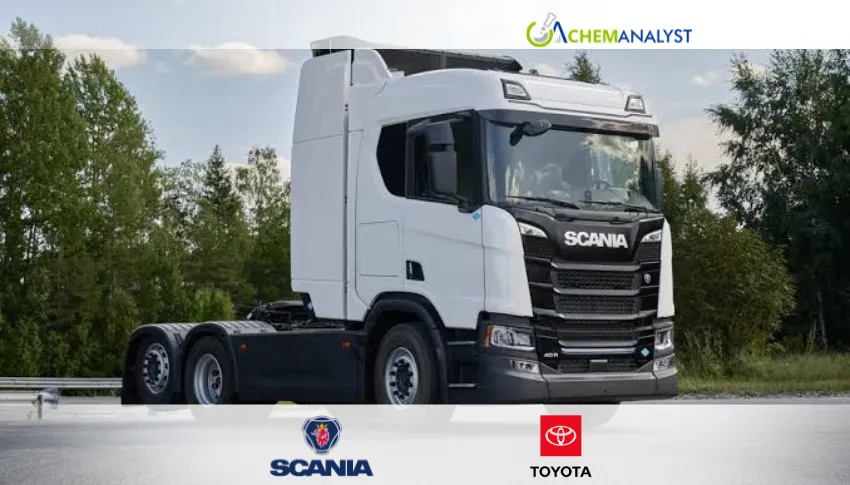
Toyota and Scania have announced a collaboration to accelerate the development and practical deployment of hydrogen fuel cell technology for heavy-duty transportation. The partnership will focus on testing fuel cell-powered trucks under real-world logistics conditions, providing both companies with valuable insights into performance, efficiency and commercial viability.
As part of the agreement, Toyota will supply its latest third-generation hydrogen fuel cell systems for 40 heavy-duty vehicles participating in Scania’s Pilot Partner programme. The programme enables Scania and selected customers to evaluate emerging sustainable transportation technologies in actual operating environments. Hydrogen fuel cell technology will be assessed alongside other low- and zero-emission solutions to determine its suitability for demanding logistics applications.
The planned vehicles will feature Toyota’s third-generation fuel cell system, which provides 300 kW of power in a compact configuration designed specifically to address the requirements of heavy-duty mobility. The technology is intended to support applications where long driving ranges, high vehicle utilization and operational efficiency are critical.
The first Scania hydrogen fuel cell electric trucks equipped with Toyota’s technology are expected to begin operations during the first quarter of 2027. Real-world deployment will allow the partners to assess the vehicles across practical logistics routes and gather data on technical reliability, energy efficiency, operating performance and total cost of ownership.
The companies believe heavy-duty transportation can play an important role in expanding hydrogen demand and supporting the development of associated infrastructure across Europe. Unlike some lighter-duty applications, heavy trucks frequently require long ranges and extended operating periods, making hydrogen fuel cells a potential alternative for applications where battery-electric systems may face operational limitations.
Toyota Executive Vice President Hiroki Nakajima said the collaboration represents an important step toward increasing the role of hydrogen-powered mobility in Europe’s heavy-duty transportation sector. He highlighted the importance of developing hydrogen demand and infrastructure while demonstrating the technology in demanding transport applications.
Scania Chief Technology Officer Sara Forsberg said the partnership will help the company understand both the opportunities and challenges associated with hydrogen fuel cell technology. Through its Pilot Partner programme, Scania works directly with customers to test emerging technologies in real-world applications and use operational feedback to further improve its solutions.
Toyota is expected to provide additional details about the collaboration during its IAA Transportation press conference on September 14. The initiative could serve as an important demonstration of how hydrogen fuel cell technology can be integrated into commercial heavy-duty fleets.
Product & Chemical Commodity Price Impact
The move is positive for hydrogen fuel cell technology, potentially accelerating demand for hydrogen, fuel-cell systems, catalysts, membranes and related components as heavy-duty adoption expands. Higher hydrogen consumption could support investment in electrolyzers and hydrogen infrastructure, benefiting the broader green hydrogen value chain. For chemical commodities tracked by ChemAnalyst, increased fuel-cell deployment may strengthen medium- to long-term demand for platinum-group metals, fluoropolymers, specialty chemicals and membrane materials used in fuel-cell manufacturing. However, the immediate price impact is likely limited because only 40 vehicles are involved and commercial-scale adoption remains years away. Successful trials from 2027 could create stronger upward demand pressure on relevant specialty chemical markets.








 About ChemAnalyst
Leave a Comment
Comments (0)