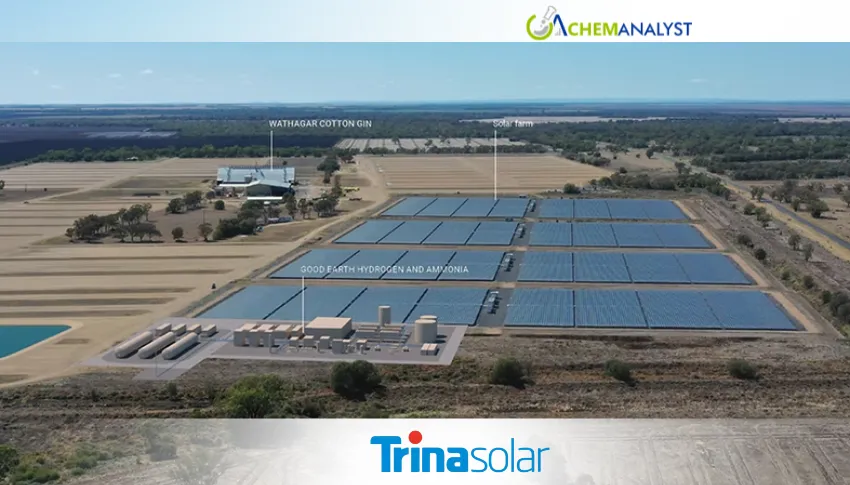
Trinasolar, a leading global provider of smart photovoltaic (PV) and energy storage solutions, has been chosen to supply high-efficiency solar modules for the Good Earth Green Hydrogen and Ammonia (GEGHA) project near Moree in New South Wales (NSW), Australia. The initiative marks a major milestone as it will become the state's first facility dedicated to producing both green hydrogen and low-carbon ammonia.
The project will feature a 27 MW solar farm equipped with Trinasolar's advanced 510W and 515W Vertex S+ (NEG18R.28) modules. These modules incorporate the company's latest n-type i-TOPCon cell technology combined with a dual-glass, heat-strengthened design. This configuration has been selected for its superior durability, weather resistance, and low degradation, ensuring reliable performance under Australia's demanding climatic conditions.
Trinasolar's n-type i-TOPCon technology significantly reduces light-induced degradation, enabling stable electricity generation throughout the project's operational life. The enhanced efficiency and long-term reliability of these modules are expected to reduce lifecycle operating costs while improving the economic viability of renewable energy infrastructure over the long term.
Construction of the GEGHA facility is currently underway. Once operational, the project is expected to produce up to 200 tonnes of green hydrogen annually along with approximately 4,500 tonnes of low-carbon ammonia. The green ammonia produced at the facility is intended to replace conventional fossil fuel-derived fertilisers, helping reduce greenhouse gas emissions from Australia's agricultural sector while strengthening domestic fertiliser production.
Edison Zhou, Head of Australia and New Zealand at Trinasolar, stated that projects such as GEGHA demonstrate the growing importance of solar power in supporting emerging industries, including green hydrogen and sustainable fertiliser manufacturing. He noted that Trinasolar's high-performance Vertex S+ modules will provide the renewable energy backbone required to power the production of green hydrogen and low-carbon ammonia.
Joe Cumming, Senior Project Manager at Hiringa Energy, highlighted that GEGHA has been designed as a commercial-scale pilot for decentralised hydrogen and fertiliser production. The project aims to establish a replicable model that could be expanded across regional Australia to strengthen energy security and reduce dependence on imported fertilisers. He added that dependable solar generation is essential for the project's success, and Trinasolar's proven expertise in the Australian market, along with its advanced dual-glass n-type technology, played a key role in the module selection process.
The project represents another significant step toward integrating renewable energy with industrial decarbonisation, supporting Australia's transition to cleaner energy systems and more sustainable agricultural practices.
Impact on Products and Chemical Commodity Prices
The GEGHA project is expected to strengthen demand for green hydrogen, green ammonia, and solar photovoltaic components, while gradually reducing dependence on conventional ammonia produced from natural gas. As renewable-powered ammonia production expands, long-term demand for fossil fuel-based ammonia feedstocks could soften. For ChemAnalyst-tracked commodities, the immediate price impact is likely to be limited because the project is relatively small. However, if similar facilities are replicated across Australia, demand for electrolysers, solar modules, and renewable energy infrastructure will rise, while prices of conventional ammonia, natural gas-based fertilisers, and related feedstocks could face mild downward pressure over the long term.






Leave a Comment
Comments (0)