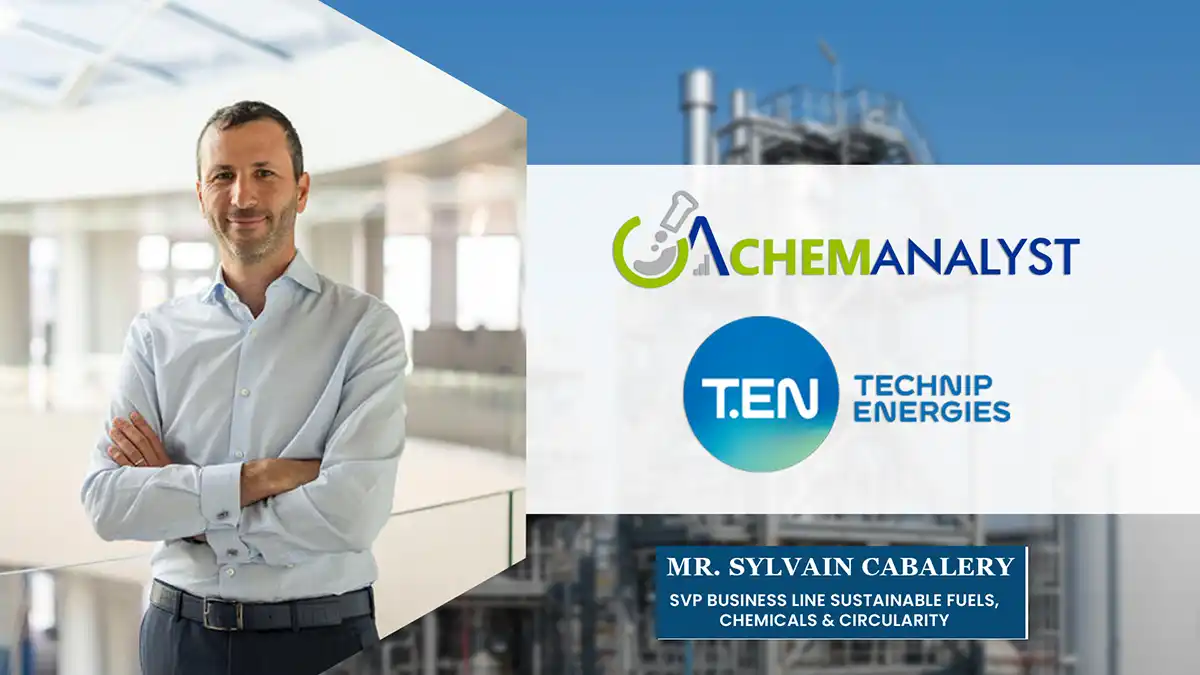
Technip Energies, a global technology and engineering leader, holds strong positions in LNG, hydrogen, ethylene, sustainable chemistry, and CO2 management. With its Technology, Products & Services (TPS) and Project Delivery segments, the company transforms innovation into scalable solutions that accelerate global transitions in energy, decarbonization, and circularity. ChemAnalyst spoke with Mr. Sylvain Cabalery, SVP Business Line Sustainable Fuels, Chemicals & Circularity at Technip Energies, to explore the company’s expanding role in renewable fuels and circular chemistry. Drawing on more than 20 years of global experience across three continents, Mr. Cabalery highlighted how strategic partnerships and trust-driven collaboration shape Technip Energies’ vision for projects like Ecoplanta—a first-of-its-kind European waste-to-chemicals facility. He explained how the combination of Enerkem’s proven waste-to-syngas technology and Technip Energies’ modular project delivery enables Ecoplanta to convert 400,000 tons of residual waste into 240,000 tons of renewable methanol annually. The project is expected to avoid 3.4 million tons of CO2-equivalent emissions in its first decade, offering a scalable pathway for decarbonizing hard-to-abate sectors. Mr. Cabalery emphasized that the company’s digital tools, integrated engineering, and strong global footprint position Technip Energies to replicate similar circular solutions across Europe and worldwide.
Complete Interview with Mr. Sylvain Cabalery
Q: Please provide an overview of your professional journey and leadership experience in the renewable fuels, chemicals, and circular economy sectors. How have these experiences shaped your strategic vision at Technip Energies in driving innovation and sustainability in projects like Ecoplanta?
Mr. Sylvain Cabalery: With over 20 years of global experience spanning across Africa, Europe, and Asia Pacific in the energy industry, and having lived and worked in 10 different countries, I can say that bringing together organizations and individuals with varied interests is something I am passionate about. I have seen firsthand what drives the success (and vice versa) of innovative and transformative projects: strong partnerships based on mutual trust and long-term vision.
Ecoplanta really showcases how collaboration and trust can significantly accelerate the shift to a low-carbon future, while demonstrating how climate action fuels innovation, drives growth, and delivers positive impacts to society.
Q: The Ecoplanta project will process up to 400,000 tons of residual municipal waste annually to produce 240,000 tons of renewable methanol. Could you elaborate on the technological and operational approach that enables this scale?
Mr. Sylvain Cabalery: In October 2024, Technip Energies and Enerkem signed a collaboration agreement to accelerate deployment of Enerkem’s process for converting non-recyclable waste and residues into sustainable fuels and circular chemical products.
Ecoplanta is a direct expression of that model: a proven Enerkem waste-to-syngas core technology coupled with Technip Energies’ project delivery and integration know-how.
Enerkem’s platform converts non-recyclable municipal waste into renewable and circular methanol, which can be used as a raw material for both circular materials and advanced biofuels.
Technip Energies provides engineering and procurement services and oversees the integration of the core technology across the balance of plant. Our modularization approach further compresses schedules, reduces site interfaces, and improves cost and execution certainty.
Q: How does the production of circular methanol from non-recyclable waste contribute to Technip Energies’ broader decarbonization and sustainability goals, especially in hard-to-abate sectors?
Mr. Sylvain Cabalery: Renewable and circular methanol are a practical way to solve two challenges at once: waste management and CO2 reduction in sectors where alternatives are limited.
Ecoplanta will show what is possible: converting 400,000 tons of non-recyclable municipal waste, diverted from landfill and incineration, into about 240,000 tons of methanol per year. From methanol, multiple downstream solutions are possible: it can be used directly as a fuel or chemically transformed into more complex products such as fuels (e.g., SAF) and a range of chemical and petrochemical applications.
Ecoplanta project is expected to avoid 3.4 million tons of CO2-equivalent in the first decade. Our role is to make projects like this viable at scale. Building on our collaboration with Enerkem, and coupled with our modularization know-how, we bring schedule, cost and performance certainty.
In short, we help clients decarbonize with a ready-to-use solution, making EcoPlanta a strategic reference for Europe’s waste-to-chemicals market. This project may be a first of its kind globally and, therefore, a catalyst for chemical circularity through waste gasification
Q: Stepping back from Ecoplanta, where does this place Technip Energies in Europe’s renewable fuels market, and how does it fit within your broader sustainable solutions portfolio?
Mr. Sylvain Cabalery: Ecoplanta strengthens our position in two key ways.
First, it places us at the forefront of waste-to-methanol with a first-of-its-kind, large-scale reference project built on proven core technology and delivered through an integrated, modular approach. This combination is precisely what project developers look for when seeking reliability at scale.
Second, it strengthens our leadership in energy-transition solutions. We are scaling multiple pathways: advanced biofuels from waste, sustainable aviation fuels, green hydrogen, e-fuels, carbon capture, and other low-carbon routes to produce fuels and chemicals. In the Iberian Peninsula, for example, we are executing Galp’s advanced biofuels unit and a 100 MW green-hydrogen unit at Sines, demonstrating that we can deliver a wide range of solutions. Combined with our strong local footprint in Spain and Portugal, Ecoplanta reinforces our credibility and provides concrete examples we can replicate across Europe and globally.
Q: Technip Energies’ strategic collaboration with Enerkem has been a key element of this project. How has this partnership accelerated the deployment of circular solutions at scale, and what lessons have emerged for future projects?
Mr. Sylvain Cabalery: Our strategic collaboration with Enerkem has been instrumental in accelerating the deployment of circular solutions at scale. By combining Enerkem’s innovative gasification technology with Technip Energies’ engineering and integration expertise, we have moved from concept to implementation far more efficiently.
This partnership has strengthened technical integration and our ability to meet sustainability targets. Ecoplanta is a first-of-its-kind project at this scale and will be delivered with a modular design to bring certainty to execution.
A key lesson is the value of aligning complementary capabilities early in the project lifecycle. This fosters agility, de-risks innovation, and ultimately drives impact. Finally, the project shows that to enable the right combination of strengths, the three parties, technology (Enerkem), operations/customer (Repsol), and project delivery (Technip Energies), have formed a joint team rather than following standard industry schemes.
Q: What technical, regulatory, or operational challenges did the Ecoplanta project encounter during its planning and early execution stages, and how were these challenges addressed?
Mr. Sylvain Cabalery: Ecoplanta is a first-of-its-kind project, so tight integration was essential from day one. Roles were clear: Repsol, as project owner, led operations and offtake needs; Enerkem provided the core process; and Technip Energies handled modularization and overall design. That clarity let us lock interfaces and key design choices before moving into execution.
Once targets were set, we engineered the conditioning line and supply chain around those specs to de-risk performance.
On the regulatory side, we adapted the design to meet European requirements while applying Repsol’s internal standards, which drove improvements across several disciplines. As execution progresses, we keep flexibility built in and rely on a robust, front-loaded definition to protect schedule and cost. In practice, we’re overcoming challenges through a joint team, clear governance, and disciplined planning.
Q: Looking ahead, does Technip Energies plan to replicate or scale waste-to-methanol or similar projects in Europe or other international markets?
Mr. Sylvain Cabalery: Absolutely. The approach can replicate elsewhere. Our modular delivery model allows us to adapt to local specifics while giving clients what matters most at scale: execution certainty and competitive cost. We see strong potential for additional projects across Europe and globally as demand grows for circularity and waste-diversion solutions.
More broadly, this is how we address the need for more energy and more energy derivatives with less emissions and less waste. By standardizing designs and delivering them modularly, we can bring low
carbon solutions to market faster and keep them affordable through repeatable fabrication and shorter on-site schedules.
Q: Is Technip Energies using digital tools, market intelligence, or procurement strategies to optimize feedstock, track market trends, and ensure the economic viability of projects like Ecoplanta?
Mr. Sylvain Cabalery: Yes. We combine digital tools, market intelligence, and disciplined procurement to keep projects like Ecoplanta both successful and economically viable. On the digital side, we use data models and AI to support our teams, from early engineering choices through procurement and operations.
This is part of our group-wide transformation, including our “AI for All” program, with tools embedded from design through start-up and operation. It reflects our vision of a “people with AI” company: AI supports our people rather than replacing them, helping them make faster, better-informed decisions.
ChemAnalyst Insights on Methanol
In Europe, the methanol market experienced a modest upswing, driven largely by limited imports and renewed restocking activity among end users. Spot prices remained firm due to tight immediate availability, even as broader index trends pointed to consolidation pressures within the market. Production costs stayed elevated, supported by higher regional energy inputs, which in turn helped maintain overall price resilience. Demand signals were mixed: while downstream formaldehyde consumption remained steady, fuel-blending demand continued to lag. Market forecasts suggested short-term strength, influenced by logistical constraints, though a potential softening was anticipated if import flows stabilize. Price trends were also shaped by inventory build-ups and ongoing export activity across key European terminals. Meanwhile, consistent operational performance at plants in France and surrounding regions ensured a steady supply, preventing sharper price increases despite the tighter spot environment.







Leave a Comment
Comments (0)