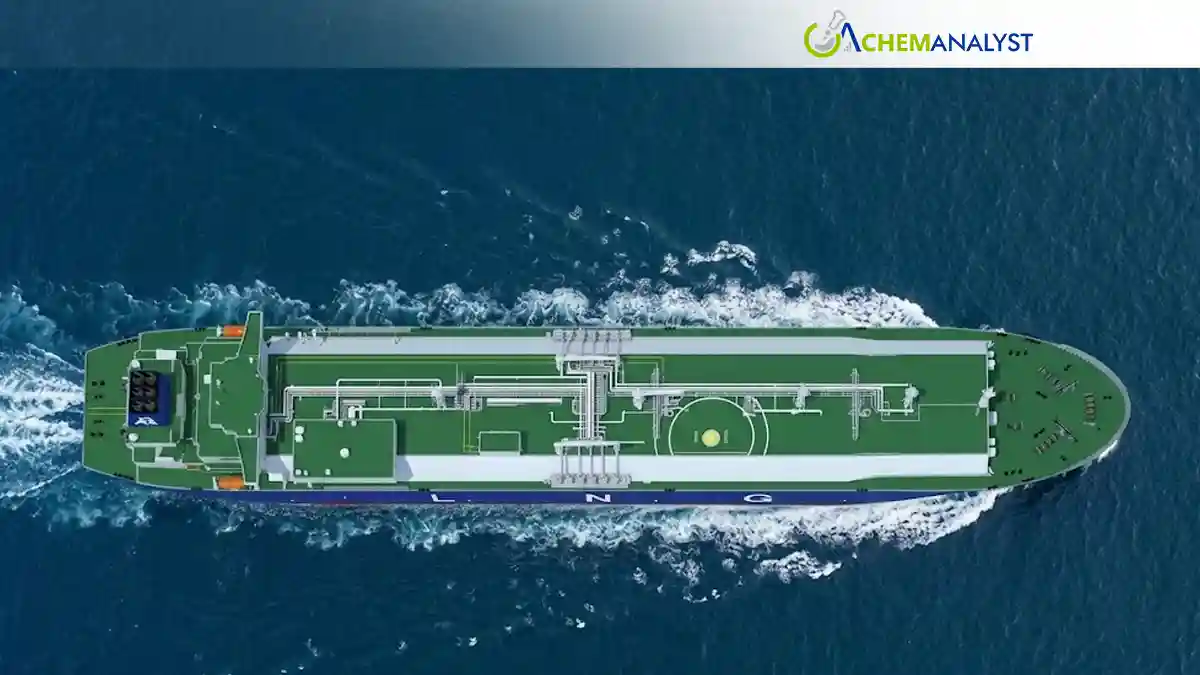
ADNOC Logistics & Services (ADNOC L&S) recently placed a new order for four liquefied natural gas (LNG) carriers, valued at approximately $900 million. This significant investment is part of a broader, ongoing fleet expansion program aimed at bolstering the company's global shipping capabilities and supporting rising worldwide demand for natural gas.
The newly ordered vessels, each with a capacity of 175,000 cubic meters, are scheduled for delivery in 2029. China's Jiangnan Shipyard in Shanghai will construct these carriers. This order is a crucial component of ADNOC L&S's extensive LNG newbuild program, which now encompasses a total of 18 vessels.
ADNOC L&S has already received six 175,000 cubic meter LNG carriers from Jiangnan Shipyard as part of an earlier $1.2 billion order. Five of these vessels have been operating under long-term contracts with ADNOC Gas since May 2026. Additionally, eight more LNG carriers, representing an investment of around $2.5 billion, are currently under construction at Samsung Heavy Industries and Hanwha Ocean, with deliveries expected to begin in 2028. All eight of these vessels are committed to ADNOC Gas through 20-year time charters.
The fleet expansion directly supports ADNOC's overarching growth strategy in the gas and LNG sector. This includes the development of the Ruwais LNG project, which aims to more than double the UAE's LNG production capacity by 2028 to 9.6 million metric tons per annum (MMtpa). The new carriers will facilitate the efficient transport of this growing global gas production to high-demand markets.
Furthermore, ADNOC recently launched a global LNG marketing and trading platform in Abu Dhabi Global Market (ADGM). This platform integrates the marketing activities of ADNOC Gas and XRG (ADNOC's international investment arm) with the trading capabilities of ADNOC Trading. It targets 47 million metric tons per annum of marketable LNG by 2035, positioning ADNOC among the leading global LNG players.
ADNOC L&S's total investment commitments for fleet expansion have surpassed $5 billion since 2022, covering 32 vessels across various types, including a 50 percent share in AW Shipping's program for ammonia and ethane carriers. This substantial investment underscores ADNOC L&S's confidence in the robust fundamentals of the LNG shipping market.
The expansion enhances ADNOC L&S's role as a critical logistics partner for ADNOC's upstream and downstream operations, strengthening the UAE's position as a global energy provider. The company strategically secures the majority of its expanded LNG capacity through long-term contracts with both third-party customers and ADNOC Group entities, ensuring stable revenue growth and strong earnings visibility for investors. The new vessels are also designed with advanced technologies, including dual-fuel capabilities, to improve energy efficiency and reduce emissions, aligning with ADNOC's commitment to a lower-carbon future.
Impact on Products and Chemical Commodities
ADNOC L&S's $900 million investment in four new LNG carriers reinforces long-term confidence in the global LNG supply chain and supports increasing exports from the UAE. While the vessels will not enter service until 2029, the order signals sustained expansion of LNG transportation capacity, improving future supply security for gas-consuming regions in Asia and Europe. The associated growth in LNG availability is expected to encourage investments in gas-based petrochemical production, including ammonia, methanol, hydrogen, and fertilizer manufacturing. For chemical commodities tracked by ChemAnalyst, the immediate price impact is likely to be limited because the vessels are years away from delivery. However, the announcement is moderately bearish over the long term for LNG and natural gas prices, as expanding shipping capacity reduces future logistics constraints. Lower and more reliable gas transportation costs could eventually support stable or softer production costs for downstream chemicals such as methanol, ammonia, urea, hydrogen, ethylene, polyethylene (PE), polypropylene (PP), and other gas-based petrochemicals, improving supply reliability and price stability globally.








 About ChemAnalyst
Leave a Comment
Comments (0)