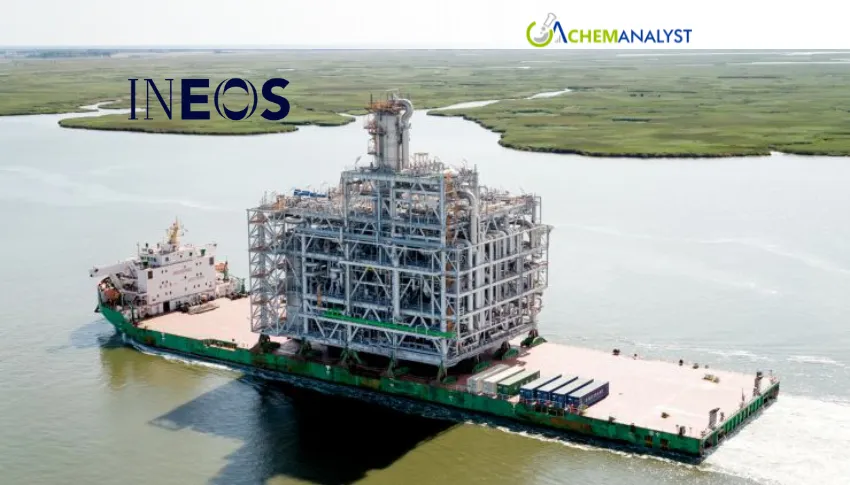
INEOS has successfully received the first of the final two large process modules required to complete its Project ONE ethane cracker at the Port of Antwerp, marking a significant milestone for one of Europe's most ambitious petrochemical projects. The delivery comes after months of uncertainty caused by geopolitical tensions in the Middle East that disrupted the transportation of the modules from Abu Dhabi to Belgium.
The two massive modules were manufactured in Abu Dhabi, but their shipment was delayed after the conflict involving Iran led to restrictions and security concerns in the Strait of Hormuz. The vessels transporting the equipment remained stranded until a one-week ceasefire in mid-June created a safe passage. The ships then transited through the Strait of Hormuz and the Suez Canal before finally reaching Antwerp approximately six weeks later.
The first module delivered is an engineering marvel, weighing 6,920 tonnes and standing 55 metres tall. Its weight is comparable to nearly the entire steel framework of the Eiffel Tower, while its height rivals that of a medium-sized skyscraper. It is among the largest and heaviest project cargoes ever handled at the Port of Antwerp, even surpassing the weight of the Project ONE furnaces delivered last year. The second module, weighing approximately 7,200 tonnes, is expected to arrive shortly, completing the delivery of all major process units.
Before installation, the transport support structures surrounding the module will be removed while the vessel remains docked. The module will then be lifted into its designated position within the cracker complex, enabling the integration of all processing units.
John McNally, CEO of INEOS Project ONE, expressed relief at the safe arrival of the final modules, noting that their delivery represents an important step toward completing the installation and preparing the facility for commissioning. He emphasized that the project remains a landmark development for Europe's petrochemical industry.
Project ONE has been built using a modular construction strategy, allowing major process units to be fabricated overseas while civil engineering and foundation work progressed simultaneously in Antwerp. This approach reduced on-site construction time, minimized logistical challenges, and optimized project execution. Following the completion of fabrication activities in Abu Dhabi earlier this year, all remaining work is now concentrated in Belgium.
Around 2,500 personnel representing nearly 80 contractors are currently working at the Antwerp site, with more than 14 million work-hours completed to date. Ongoing activities include mechanical installation, electrical and instrumentation work, cable laying across approximately 1,250 kilometres, leak testing, and completion of key operational buildings. The commissioning process has already begun for completed subsystems following the energization of the site's 380 kV substation. Mechanical completion of the entire complex is expected by next summer, with commercial startup targeted for the second half of 2027.
Impact on Chemical Commodity Prices Chemanalyst
The successful delivery of the final Project ONE modules improves confidence that the cracker will begin operations in the second half of 2027, supporting future growth in European ethylene supply. Although no immediate price impact is expected, the project increases expectations of improved regional availability of ethylene, which could gradually ease pricing pressure after startup. Greater ethylene production may also influence downstream commodities tracked by ChemAnalyst, including polyethylene (HDPE, LDPE, LLDPE), ethylene oxide, monoethylene glycol (MEG), styrene, vinyl acetate monomer (VAM), and PVC through improved feedstock availability. Until commissioning, market prices are likely to remain primarily driven by crude oil, naphtha, and regional demand-supply fundamentals.






Leave a Comment
Comments (0)