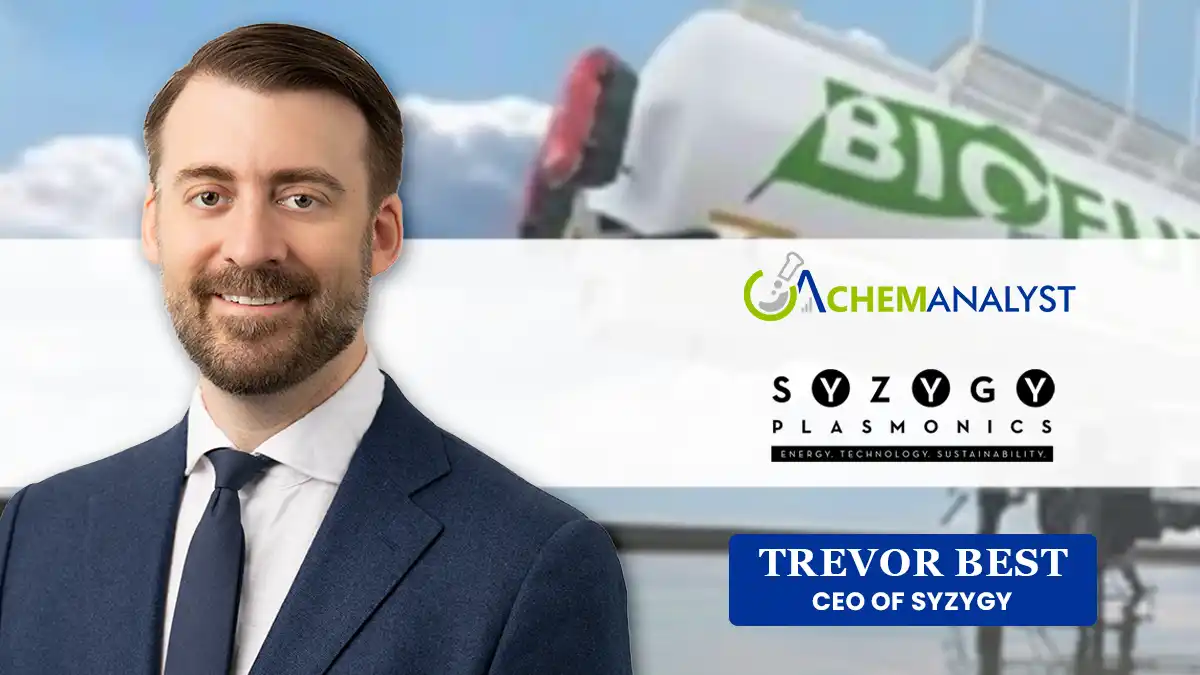
ChemAnalyst Talks with Mr. Trevor Best, CEO of Syzygy Plasmonic
Syzygy Plasmonics, a Houston-based technology company, is pioneering the decarbonization of chemical and fuel production through its proprietary light-driven reactor technology. By replacing fossil-fuel combustion with renewable electricity, the company enables the production of sustainable aviation fuel (SAF) at highly competitive costs while dramatically reducing carbon intensity. Leveraging advances in photocatalysis and reactor design, Syzygy’s platform supports scalable, modular deployment across distributed feedstocks such as biogas, positioning the company at the forefront of next-generation clean fuels. ChemAnalyst spoke with Mr. Trevor Best, Chief Executive Officer of Syzygy Plasmonics, about the company’s evolution from foundational science to commercial deployment and its ambition to transform fuels and chemical production. Best highlighted how Syzygy’s light-driven reactor technology enables higher efficiency, lower costs, and enhanced catalyst durability, and discussed NovaSAF™ as a cost-competitive, low-carbon pathway for producing sustainable aviation fuel from biogenic methane, compliant with key European and UK regulatory frameworks. Looking ahead, he underscored the company’s focus on cost leadership, modular scale-up, and strategic partnerships to drive system-level impact, while expanding the technology beyond aviation fuel into hydrogen, e-fuels, and chemical intermediates.
Complete Interview with Mr. Trevor Best
Q: Could you give us the elevator pitch of your journey? How did you end up building a company at the intersection of photonics, catalysis, and clean fuels?
Trevor Best: To understand my journey, it helps to go back about 15 years, to around 2009–2010, when I was beginning my career at Baker Hughes. Over time, I moved into the new product development group, where I worked on advanced technologies for the energy industry. That role is where I met my co-founder, Dr. Suman Kadiwada. Between the two of us, we worked on more than 100 product development projects. Through that experience, we gained a clear understanding of what effective R&D looks like, what doesn’t work, and—most importantly—what the market is actually willing to adopt. We also learned what it truly takes to scale an energy technology globally. Fast forward to 2015 and 2016. My co-founder and I were closely following reports from the Intergovernmental Panel on Climate Change, which emphasized the urgency of bold action. We decided we wanted to find a transformative technology where we could apply everything we had learned. It became clear that if we wanted to disrupt the industry meaningfully, we would have to build something ourselves. We evaluated dozens of scientific papers and technical concepts. In late 2016, we came across the foundational research behind what eventually became Syzygy’s technology. My co-founder leveraged his alumni connection with Rice University to connect with the professors behind the work. After months of diligence, we couldn’t find a reason it wouldn’t work. In 2017, we made the leap—leaving our jobs, investing our life savings, and launching the company. We raised our first round in 2018. Since then, the journey has been remarkable: over $135 million raised, and technology performance that has exceeded even our most ambitious expectations.
Q: As CEO, how do you balance long-term innovation with the near-term pressure to commercialize in today’s fast-moving energy transition?
Trevor Best: It’s a constant balance between the long-term market opportunity and the current maturity of the technology. You have to assess how large and impactful the end market could be, while also staying grounded in what can be delivered today.
For much of Syzygy’s history, we benefited from the clean-tech momentum that accelerated around 2020, particularly in hydrogen. There was strong investor interest and policy support, which created a favorable environment for fundraising and development. Our technology is inherently platform-based—it can enable many different chemical reactions—so we initially focused on hydrogen as a large and visible market. As market dynamics evolved and hydrogen faced headwinds, we adapted. We applied the same core technology to sustainable aviation fuel, where demand, mandates, and enthusiasm remain strong. Ultimately, success requires flexibility, multiple value propositions, and the ability to align innovation with what the market is actively pursuing.
Q: When you think about Syzygy ten years from now, what does “winning” actually look like—technology adoption, market share, or system-level impact?
Trevor Best: For me, winning is about system-level impact, and it can be distilled into one word: price. True success means delivering a lower-cost solution than competing pathways. Hydrogen and sustainable aviation fuel are ultra-commodity markets—low margins, very high volumes. If you want to make a meaningful difference, you must win on cost. Our mission is to deliver the most affordable sustainable aviation fuel possible and, within the next decade, reach price parity with conventional jet fuel.
Q: For viewers who aren’t chemical engineers—how does Syzygy’s light-driven reactor technology fundamentally differ from conventional thermocatalytic processes?
Trevor Best: The best way to explain this is to start at the atomic level and then zoom out. In conventional thermocatalysis, molecules bind to a catalyst surface and absorb heat energy to drive reactions. This process is relatively slow and often leads to issues such as coking, where carbon deposits accumulate and degrade catalyst performance over time. Our approach combines highly efficient light-harvesting nanoparticles with traditional catalyst nanoparticles. Photons are absorbed and directly transfer energy to the catalyst, enabling reactions to occur roughly two orders of magnitude faster than thermal processes. Simply put, light moves faster than heat. This allows us to perform dramatically more chemical reactions in the same amount of time, using compact reactors with very high productivity. Additionally, light interactions help remove surface deposits, giving our catalysts inherent anti-coking and anti-oxidation properties. That enables us to process challenging feedstocks like biogas. At the reactor level, we embed highly efficient light sources—about 95% efficient—in the catalyst bed itself. Unlike thermal systems, where heat transfer losses are significant, nearly all of our energy flows directly into the catalyst. This design enabled us to achieve over 80% energy efficiency in our first field trial at Lotte Chemical. At the system level, we use renewable electricity instead of combustion, meaning no direct emissions—resulting in compact, efficient, and clean chemical production.
Q: Compared with other SAF pathways—like HEFA, ATJ, or FT—where does NovaSAF™ really shine on cost, scalability, and carbon intensity (CI)?
Trevor Best: NovaSAF™ converts biogas—from sources such as landfills and anaerobic digesters—into sustainable aviation fuel. Biogas is first converted to syngas in our reactor, then upgraded via Fischer-Tropsch synthesis and hydroprocessing to produce ASTM-spec SAF. In regions with abundant biogas and low-cost renewable power, our levelized cost can be lower than HEFA. With continued reactor improvements, we believe costs could reach approximately $3 per gallon—competitive with conventional jet fuel. From a carbon perspective, third-party lifecycle assessments indicate a carbon intensity of about 9gCO2e/MJ, representing roughly a 90% reduction compared to fossil jet fuel. The process is also pre-qualified for major regulatory frameworks, having been assessed against RED, RFNBO and advanced BioSAF requirements. The combination of low cost and very low carbon intensity makes NovaSAF™ highly disruptive.
Q: NovaSAF-1 is being positioned as a blueprint project. What were the biggest technical or execution risks you had to de-risk first?
Trevor Best: NovaSAF-1, located in Durazno, Uruguay, is the first project to integrate the full value chain—from raw biogas to on-spec SAF eligible for European and UK mandates. All of NovaSAF-1’s output has already been committed under an offtake agreement with Trafigura, which will market the fuel into Europe. This project allows us to validate technical performance, logistics, and certification at commercial scale. Once operational, it becomes a blueprint for larger and more economical plants in regions such as Brazil, Mexico, and the Dominican Republic. Trafigura has also reserved capacity from future projects, making them a long-term strategic partner.
Q: Modular design is a buzzword across clean tech. How does modularity actually help you scale faster and reduce CAPEX risk?
Trevor Best: Modularity reduces both engineering complexity and capital risk. Rather than redesigning systems for each project, we mass-manufacture standardized modules. This significantly reduces front-end engineering and accelerates deployment. The real CAPEX advantage comes from manufacturing scale—similar to the automotive industry. Biogas sources are distributed, so modular systems allow us to deploy multiple identical units across many locations. Ordering components in volume dramatically reduces costs and shortens timelines.
Q: The long-term offtake agreement with Trafigura turned heads across the industry. Why was this partnership such a pivotal milestone for Syzygy?
Trevor Best: For Syzygy, this agreement marks our transition from technology development to commercial execution. Trafigura is one of the world’s most sophisticated commodity traders—they only engage where economics are compelling. For the industry, this partnership shows the potential behind a new RFNBO-compliant SAF pathway outside traditional power-to-liquids. Given that our cost structure is roughly half that of conventional PtL pathways, this provides Europe with a far more affordable route to meeting mandates. It’s a milestone that will have long-term implications.
Q: With SAF mandates emerging across the EU, UK, and beyond, how important are policy frameworks versus pure market demand in driving adoption?
Trevor Best: Policy is essential, particularly in the early stages. First-of-a-kind plants are expensive and cannot compete immediately with fully scaled legacy technologies. Mandates help bridge this “valley of death” by creating guaranteed demand. SAF mandates typically start small—1% and gradually increase—allowing adoption without destabilizing airline economics. This model has already been adopted across Europe, Asia, and the Middle East, and it’s critical for enabling innovation at scale.
Q: Feedstock availability has been a major constraint for SAF. Does biogas meaningfully change the feedstock conversation?
Trevor Best: Absolutely. Roughly 10% of global greenhouse gas emissions come from anthropogenic methane. By capturing even a portion of that methane and converting it into SAF, we turn a major climate liability into a valuable resource. According to the IEA, global biogas potential could theoretically support up to 500 million tonnes of SAF annually—well above current global jet fuel demand. While not all of it will be economical, biogas is abundant, distributed, and largely underutilized.
Q: Renewable electricity is a core input for NovaSAF™. How sensitive are your project economics to power prices and grid reliability?
Trevor Best: Power cost is important, but we are less sensitive than traditional power-to-liquids pathways. We require roughly 11 MW per tonne of fuel, compared to around 40 MW for PtL systems. Our economics work well with power prices in the $50–70/MWh range, provided the electricity is renewable. This flexibility expands our geographic options significantly.
Q: When evaluating project locations, what usually wins—policy incentives, clean power access, biogas supply, or proximity to aviation hubs?
Trevor Best: All of these factors matter, but logistics and proximity play a critical role. Efficient feedstock access and fuel distribution can ultimately determine project viability.
Q: The SAF space is getting crowded with new pathways and startups. How do you think competitive dynamics will evolve over the next five years?
Trevor Best: HEFA currently dominates the market but will eventually face feedstock constraints. Power-to-liquids and alcohol-to-jet remain promising but economically challenged. We believe biogas-to-SAF will emerge as a major pathway over the next decade. As competition intensifies, access to feedstock and cost leadership will define winners. In many ways, we’re entering a land-grab phase.
Q: Looking past SAF, where else do you see Syzygy’s technology creating value—clean hydrogen, e-methanol, chemicals, or industrial heat?
Trevor Best: Our core innovation—transforming traditional catalysts into high-performance photocatalysts—has broad applicability. Beyond SAF, we’ve demonstrated hydrogen, ammonia, ethylene, butadiene, and many other reactions. SAF is our beachhead, but over time we intend to deploy this technology across the chemical and fuels landscape.
Q: As we move toward a low-carbon fuels economy across aviation, shipping, and chemicals, how does Syzygy decide where to place its bets?
Trevor Best: We continuously assess techno-economics, policy support, and adoption barriers. Hydrogen was an early focus, but unrealistic cost assumptions led us to pivot toward SAF, where mandates and drop-in compatibility exist.
Looking forward, trends such as deglobalization and CO2 utilization may create opportunities in localized chemical production and methanol. Our modular approach positions us well for these emerging needs.
Q: Finally, on a personal note—what excites you most right now: the technology breakthroughs, the commercial traction, or the chance to reshape how fuels are made?
Trevor Best: All of it excites me, but if I had to choose one, it’s the elegance of the core catalyst technology. The fundamental science only fully understood in the past decade—is beautiful, powerful, and fundamentally superior to legacy approaches. That’s what truly motivates me.







Leave a Comment
Comments (0)