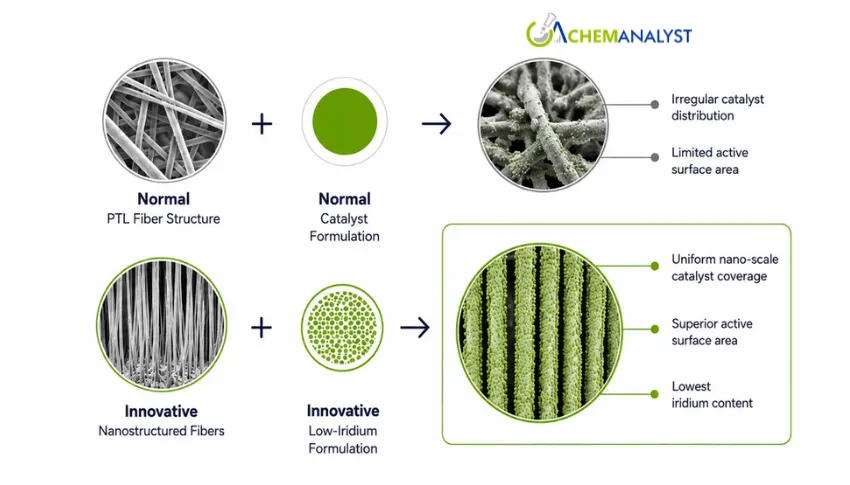
Smoltek Hydrogen, a subsidiary of Smoltek Nanotech Holding AB, and Heraeus Precious Metals are advancing their strategic collaboration to develop next-generation Porous Transport Electrodes (PTEs) with ultra-low iridium content for Proton Exchange Membrane (PEM) water electrolysis.
As a major milestone in their partnership, the companies plan to launch an extensive 3,000-hour long-term durability test this autumn. The testing program will assess the operational stability and performance of Smoltek Hydrogen’s proprietary nanostructured iridium catalyst layer under conditions designed to reflect practical electrolyzer operations. The results will represent an important step toward commercializing and scaling more cost-effective green hydrogen production technologies.
The collaboration combines Smoltek’s expertise in nanotechnology with Heraeus Precious Metals’ capabilities in precious-metal electrocatalysts, material analysis, and hydrogen-system testing. The partnership aims to address one of the most significant cost challenges associated with PEM electrolyzers: their reliance on iridium.
According to Smoltek Hydrogen’s Head of R&D Fabian Wenger, the company’s nanostructured catalyst layer is designed to improve charge and mass transport within a catalyst layer only a few microns thick. Through this architecture, Smoltek aims to maintain high electrolyzer efficiency while reducing iridium loading to below 0.1 milligrams per square centimeter.
The upcoming durability campaign will be led by Heraeus Precious Metals, which will conduct performance testing and material analysis under realistic operating conditions. The testing is intended to provide critical data on the catalyst’s long-term stability and help validate its suitability for industrial applications.
Christian Gebauer, Head of Innovation at the Hydrogen Systems Division of Heraeus Precious Metals, said the company will support the project through comprehensive analytical and testing capabilities. The objective is to accelerate the transition of ultra-low iridium PTE technology from development toward industrialization.
Reducing iridium consumption could have important implications for the future expansion of PEM electrolysis. Iridium is a scarce and expensive precious metal, and its availability and cost remain major concerns for large-scale electrolyzer deployment. A technology capable of substantially lowering iridium requirements while maintaining efficiency and durability could reduce material costs and improve the economics of green hydrogen projects.
The 3,000-hour test will therefore serve as a critical validation stage. Successful results could strengthen the technology’s commercialization prospects and support broader adoption of PEM electrolyzers for green hydrogen production.
Impact on Product & Chemical Commodity Prices
The development could have a positive long-term impact on green hydrogen economics by reducing iridium requirements in PEM electrolyzers while maintaining performance. If the 3,000-hour durability test confirms commercial viability, demand growth for PEM systems could accelerate, supporting hydrogen production and related catalyst markets. However, lower iridium intensity per electrolyzer could moderate long-term iridium demand growth, potentially limiting upward price pressure on the metal as electrolyzer deployment expands. For chemical commodities tracked by ChemAnalyst, stronger green hydrogen adoption could support demand for hydrogen, ammonia and methanol, while potentially improving cost competitiveness for hydrogen-derived chemicals. Near-term commodity-price effects are expected to remain limited until commercialization advances.







Leave a Comment
Comments (0)