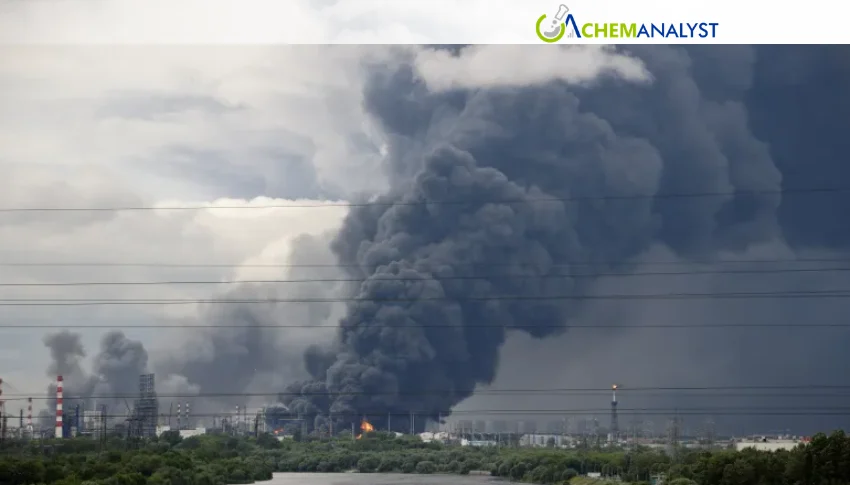
Ukraine launched another major long-range drone offensive against Russia, targeting two strategically important energy facilities located deep inside Russian territory. One of the strikes reportedly hit Gazpromneftekhim Salavat in Bashkortostan, approximately 1,500 kilometers from the Ukrainian border, making it one of the deepest attacks of the conflict. Videos circulating on social media and reports from independent Russian media suggested multiple explosions followed by a significant fire at the petrochemical complex.
The Salavat facility is among Russia's largest integrated refining and petrochemical hubs, producing gasoline, diesel, aviation fuel, liquefied petroleum gas (LPG), butyl alcohols, ammonia, urea, and several petrochemical feedstocks. The plant processed around 7.2 million metric tons of raw materials in 2024, accounting for nearly 2.7% of Russia's refining capacity. It was reportedly the last major Russian gasoline producer to avoid a successful Ukrainian strike in 2026.
Ukraine also targeted the Afipsky Oil Refinery in Krasnodar Krai, another key refining facility with an annual processing capacity of 6.25 million metric tons. Reports indicated that a fire erupted near the refinery's storage tanks, where export-oriented petroleum products, including gasoline, diesel, fuel oil, sulfur, and gas condensates, are stored. The refinery has previously been targeted by Ukrainian drones this year.
Ukraine's General Staff later confirmed both strikes, stating that damage assessments remain underway. Additionally, Ukrainian forces reportedly attacked an oil transshipment terminal near Gelendzhik, along with military logistics facilities in occupied Donetsk and Luhansk. Meanwhile, Russia's Defense Ministry claimed its air defense systems intercepted 288 Ukrainian drones across multiple regions during the same period.
Impact on ChemAnalyst-Tracked Chemical Commodity Prices
The latest Ukrainian drone strikes are expected to have a moderately bullish impact on several chemical commodities tracked by ChemAnalyst, particularly those linked to energy and refinery operations.
• Crude Oil: Prices may witness short-term upward pressure due to renewed geopolitical risk premiums despite no direct loss in crude production.
• Gasoline and Diesel: Likely to strengthen in Europe and the Black Sea region if refinery utilization declines.
• LPG (Propane/Butane): Prices could edge higher if production from Salavat remains disrupted.
• Ammonia: Mild upward pressure is expected as the Salavat complex is a notable producer, although global supply remains relatively balanced.
• Urea: Limited price gains are possible if ammonia production interruptions persist, especially for regional export markets.
• Sulfur: Prices may rise slightly because refinery sulfur recovery could be temporarily affected.
• Petrochemical Feedstocks (Naphtha and Vacuum Gas Oil): Could see firmer pricing if refinery output falls, increasing production costs for downstream petrochemical manufacturers.
Overall, unless the facilities remain offline for an extended period, the market impact is expected to remain short-term and sentiment-driven rather than causing sustained global supply shortages. However, repeated attacks on Russian energy infrastructure could gradually tighten regional fuel availability and keep energy-linked chemical prices supported in the coming weeks.


 About ChemAnalyst
Leave a Comment
Comments (0)