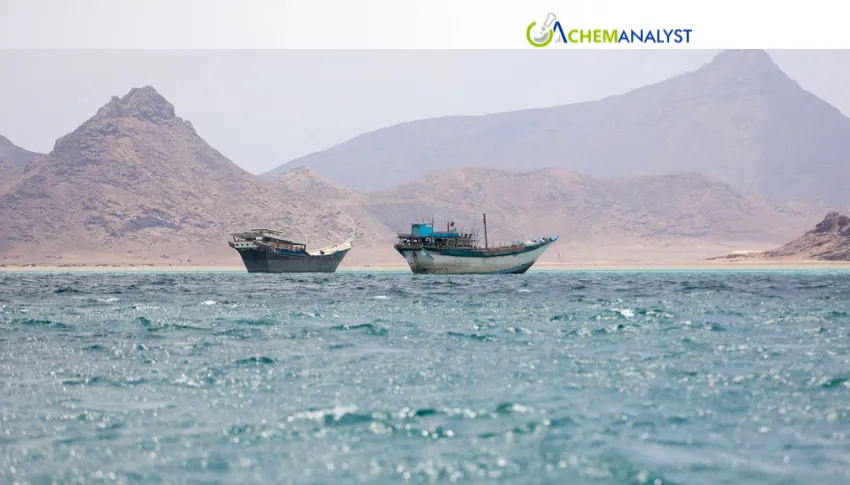
Shipping activity through the Bab el-Mandeb Strait declined sharply after Yemen's Houthi rebels launched attacks on Saudi oil facilities along the Red Sea coast, according to Kpler shipping data released on Monday. The disruption has further intensified concerns over energy supply routes in the Middle East, adding pressure to global oil markets.
Only 11 commodity vessels crossed the Bab el-Mandeb Strait on Sunday, marking the lowest daily traffic recorded in several months. Since last week, Red Sea shipping has faced mounting challenges due to attacks by the Iran-backed Houthi group, which has sought to block Saudi exports. The escalation comes amid broader geopolitical tensions involving the United States and Iran, which have already affected crude flows through the Strait of Hormuz.
The disruption has pushed physical crude oil prices in the Middle East, Europe, and Africa to their highest levels in nearly two months, as buyers factor in higher transportation risks and possible supply delays.
Among the vessels that transited the Bab el-Mandeb Strait on Sunday, seven were oil tankers. Three entered the Red Sea, including two very large crude carriers (VLCCs) destined for Saudi Arabia's Yanbu port to load crude oil. Another vessel linked to Russia also entered the region.
Four vessels departed the Red Sea on the same day. These included the Hong Kong-flagged VLCC New Explorer, transporting around two million barrels of Saudi and Emirati crude to Ningbo, China. Another tanker carried approximately one million barrels of Russian crude to China, while a third transported nearly 750,000 barrels of Saudi crude to Pakistan. Additionally, the VLCC New Pearl, carrying two million barrels of Saudi crude, exited the Red Sea en route to Zhoushan, China, becoming the fourth Chinese supertanker to leave the region since the Houthis announced a naval blockade.
The manager of both Hong Kong-flagged vessels, Associated Maritime Hong Kong, did not immediately respond to requests for comment.
Houthi military spokesperson Yahya Saree claimed responsibility for strikes targeting facilities owned by Saudi Aramco in the cities of Jizan and Yanbu on Saturday.
Meanwhile, vessel traffic through the Strait of Hormuz also remained subdued. Fewer than 10 commodity vessels passed through the strategic waterway each day over the weekend despite a pause in military strikes between the United States and Iran. On Sunday, seven vessels transited the strait, including three Iranian-linked oil product tankers. On Saturday, only three ships were recorded, all operating with their transponders switched off, including a VLCC heading to Qatar, an LPG carrier bound for the UAE's Ruwais port, and a tanker carrying Qatari naphtha to Japan. Friday witnessed seven vessel movements, primarily crude and fuel cargoes departing the Gulf.
Impact on Products and ChemAnalyst Chemical Commodity Prices
The disruption in Red Sea and Strait of Hormuz shipping is expected to increase freight rates, insurance premiums, and transit delays for crude oil, refined fuels, LPG, and petrochemical feedstocks. Higher logistics costs could lift prices of naphtha, LPG, propylene, ethylene, benzene, toluene, xylene, methanol, and downstream polymers tracked by ChemAnalyst, particularly across Europe, Asia, and Africa. Fertilizers and base chemicals dependent on Middle Eastern exports may also witness short-term price gains due to tighter supply. However, if shipping routes normalize quickly and geopolitical tensions ease, the upward pressure on chemical and energy commodity prices is likely to moderate.








 About ChemAnalyst
Leave a Comment
Comments (0)